

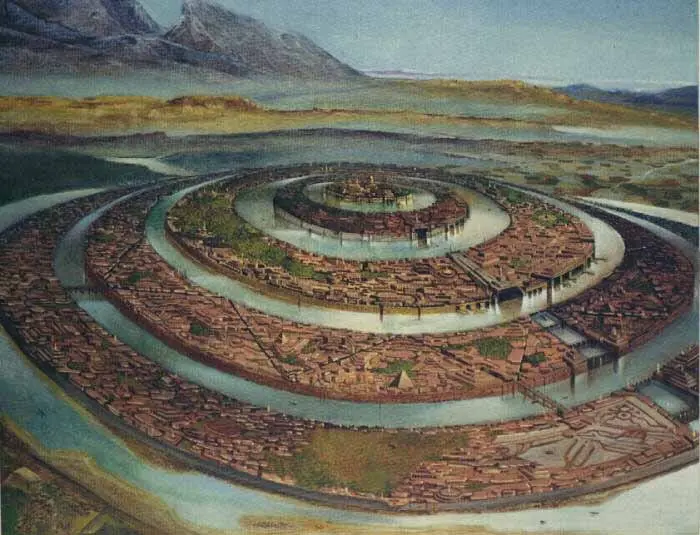
Every time we think about Atlantis—the fabled lost city/continent—we think about Plato, the man who described its existence in his work Critias and Timaeus. But have we ever asked ourselves where does
Every time we think about Atlantis—the fabled lost city/continent—we think about Plato, the man who described its existence in his work Critias and Timaeus.
But have we ever asked ourselves where does the original story from Atlantis come from?
Plato did not invent Atlantis as many believe, but the story of the existence of this ‘mythical’ city/continent can be traced back in history.
To understand more about Atlantis, we must venture out and learn more about Solon, a highly respected and well known Greek Statement who lived between 638 BC – 558 BC.
Solon was a famous lawgiver of Athens, and he was notable for his poems and writings.
As explained by Plato, Solon travels to ancient Egypt to learn more about the history of its country, and look for potential trading outposts between Greece and Egypt.
It is believed that in an ancient tale, Solon wrote about the mythical city-continent of Atlantis—an elusive empire that has captured the interest and imagination of historians, archeologists, adventurers, philosophers and others for more than two thousand years.
So, who wrote about Atlantis first?
Well, from what we are able to understand, it was An Egyptian priest of very great age, named Sonchis, Sonchis of Sais— Sais being an ancient Egyptian town in the Western Nile Delta on the Canopic branch of the Nile.
Solon, after his travels to Egypt, met Sonchis, who in turn told him a great ancient civilization that had disappeared from Earth 9,000 years ago. Among many other things, it is believed that Sonchis told Solon stories about a series of ancient empires that existed on Earth, natural catastrophes that made them crumble, and great wars that had raged civilization in the past.
During his time in the city of Sais, Solon learned great information about Atlantis from Sonchis who described the incredible size and wealth of the Atlantean empire as best as he could.
Sonchis explained that Atlantis’ capital city was elaborately constructed, where great temples and palaces were erected, adorned by exotic gardens made of silver, gold and, ivory. Sonchis further described the capital of the Atlantean empire as being made of massive walls, which in turn were surrounded by circular islands protecting the inner citadel of the metropolis.
But, let's hold on there for a sec and look at what Plato had to say about Sais, Atlantis and the priest who allegedly introduced the world to Atlantis.
First of all, we have to mention that the existence of Sonchis of Sais is a matter of debate among experts who cannot agree whether or not he actually existed.
 An interpretation of Atlantis according to the Greek philosopher Plato.
Having that said, in Timaeus and Critias, written around 360 BC Plato described—through the voice of Critias—how Solon traveled to Sais and met with priests from the goddess Neith. It is there where an extremely old priest tells Solon about an empire that existed 9,000 years before him, which was at war with Athens. Eventually, this empire identified as ‘Atlantis’ was destroyed by a great catastrophe.
Plato does not mention the name of the Priests who told Solon about Atlantis, but Plutarch (46–120 AD), in his Life of Solon identified the priest as Sonchis:
Near Nilus' mouth, by fair Canopus' shores, and spent some time in study with Psenophis of Heliopolis, and Sonchis the Saïte, the most learned of all the priests; from whom, as Plato says, getting knowledge of the Atlantic story, he put it into a poem, and proposed to bring it to the knowledge of the Greeks.
So, this means that the history of Atlantis can briefly be resumed like this:
An empire existed 9,000 years before the life of Solon, and the Egyptian Priest Sonchis.
Atlantis eventually is destroyed by a catastrophe, and nearly all records of its existence are lost.
The only records remain are shared among priests of ancient Egypt.
Eventually, Solon travels to Sais where he meets an ancient Priest who knew about Atlantis.
 Athanasius Kircher's map of Atlantis, placing it in the middle of the Atlantic Ocean, from Mundus Subterraneus 1669, published in Amsterdam. The map is oriented with south at the top. Image Credit: Wikimedia Commons

Identified later as Sonchis of Sais, this priest explains to Solon that Atlantis was an extremely powerful empire that existed 9,000 years before them, and was eventually destroyed.
Solon returns to Greece where he mentions the existence of Atlantis.
Later, in Timaeus and Critias written in 360 BC, Solon traveled to Egypt and that he learned about the existence of Atlantis from an ancient Priest.
Plato writes that Atlantis was located in Timaeus:
“For it is related in our records how once upon a time your State stayed the course of a mighty host, which, starting from a distant point in the Atlantic Ocean, was insolently advancing to attack the whole of Europe, and Asia to boot. For the ocean there was at that time navigable; for in front of the mouth which you Greeks call, as you say, 'the pillars of Heracles,' there lay an island which was larger than Libya and Asia together; and it was possible for the travelers of that time to cross from it to the other islands, and from the islands to the whole of the continent over against them which encompasses that veritable ocean. For all that we have here, lying within the mouth of which we speak, is evidently a haven having a narrow entrance; but that yonder is a real ocean, and the land surrounding it may most rightly be called, in the fullest and truest sense, a continent. Now in this island of Atlantis there existed a confederation of kings, of great and marvelous power, which held sway over all the island, and over many other islands also and parts of the continent…” –Timaeus 24e–25a, R. G. Bury translation.
 Lost Civilizations
Atlantis; The Lost Continent
Atlantis; the mythical land of a highly advanced and powerful civilization, but what do we know about them? Atlantis was mentioned in Plato’s dialogues “Timaeus” and “Critias” even though mainstream a
 Lost Civilizations
Where is Atlantis
The globe is full of mysteries. There are lost cities, ancient civilizations, and unsolved puzzles. One of the most famous mysteries is the story of Atlantis. The legend of Atlantis tells the story of
 Lost Civilizations
Have The Ancient Ruins Of Atlantis Been Found In Antarctica?
YouTube Video Here: https://www.youtube.com/embed/EZDScpQ47Mk?feature=oembed&enablejsapi=1 I mean who doesn't want to find Atlantis, right? According to satellite images on Google Earth, there is