
Enki ("En" Lord, "ki" Earth), or Ea ("E" Temple, "A" Water) is one of the three most important gods of Mesopotamian culture. He is the god of wisdom, lord of magic, construction, arts, design, and cre
Enki ("En" Lord, "ki" Earth), or Ea ("E" Temple, "A" Water) is one of the three most important gods of Mesopotamian culture. He is the god of wisdom, lord of magic, construction, arts, design, and creation.
Enki has been interpreted as The Lord of Earth; He was the stepbrother of the god Enlil, and son of An.
His sole mission was to create men and to encourage other deities to believe in them. Enki was also the original patron God of the ancient city of Eridu, and his influence spread throughout history throughout Mesopotamia and to the Canaanites, Hittites and even Hurrians.
Interestingly, Enki was associated with the southern band of constellations called stars of Ea, but also with the constellation AŠ-IKU—Pegasus, a constellation in the northern sky.
Sometime during the second millennium BCE, Enki was referred to in writing by the numeric ideogram for "40," which was also referred to as His "sacred number.”
Enki is the creator of mankind—according to what is told in the epic legend Acadia of Atrahasis—solely for the purpose of releasing the gods from their work. Enki used an existing hominid which he (Genetically?) manipulated in some in order to make man capable of understanding and meet the needs of the gods.
He is also later considered mankind’s savior since he warned Ziusudra of the universal flood.
The Universal flood was brought upon mankind by Enlil, the "Lord of Heaven (air or atmosphere)".
[caption id="attachment_25328" align="aligncenter" width="1000"] Enki, the Creator God of mankind.[/caption]
Before the divine assembly, apparently worried about the excessive proliferation of the human race and uncanny behavior Enlil proposed to put an end to humanity.
Enlil managed to convince the rest of the gods, gathered in assembly, to authorize the extermination of Humanity.
This legend probably gave rise to the later biblical account of Noah and the universal flood.
He was the master shaper of the earth, god of wisdom and of all magic, Enki was described as the lord of the Abzu (Apsu in Akkadian), the freshwater sea or groundwater located within the earth— where "primordial waters" flow.
He is also the creator of the apkallu (ab-gal-lu "great man-fish" in Sumerian) who during the day taught men in all kinds of subjects, and at night they retired to the bottom of the sea.
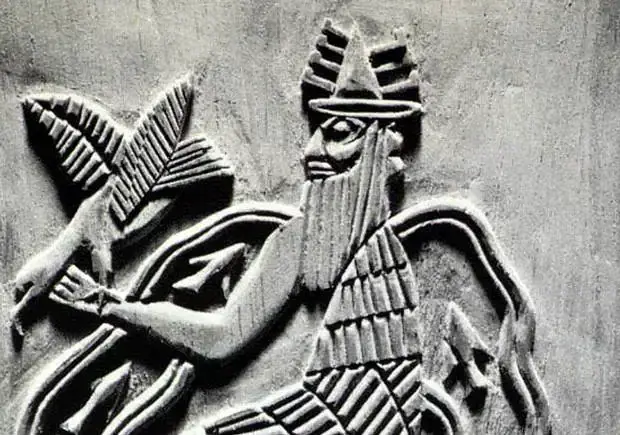
[caption id="attachment_25330" align="aligncenter" width="1005"] Enki was the keeper of the divine powers called Me, the gifts of civilization. Image credit[/caption]
Interestingly, Enki was considered the keeper of the divine powers called Me, the gifts of civilization. Enki’s image was a double-helix snake or the Caduceus, sometimes confused with the Rod of Asclepius used to symbolize medicine.
Enki created the first seven wise men or "Abgallu" (Ab = water, Gal = great, Lu = Man), also known as Adapa using the blood of slain Kingu.
Adapa, the first man, fashioned, later goes and acts as the advisor to the King of Eridu, when in the Sumerian king list, the "Me" of "kingship descends on Eridu".
The main temple to Enki was called E-abzu, meaning "abzu temple." It was a ziggurat temple surrounded by Euphratean marshlands near the ancient Persian Gulf coastline at the ancient city of Eridu.
It is considered the very first temple known to have been built in Southern Iraq.
Four separate archaeological excavations at the site of Eridu have demonstrated the existence of a shrine dating back to the earliest Ubaid period, more than 6,500 years ago. Over the following 4,500 years, the temple was expanded 18 times, until it was abandoned during the Persian period.
It is believed that over the following 4,500 years, the temple was expanded up to 18 times until it was eventually abandoned during the Persian period.
 Sumer & the Anunnaki
Lake Titicaca and the Anunnaki
The Anunanki are considered by many as the "founding fathers" of civilization and mankind, the cradle of civilization is considered to be in Sumer. Some archaeologists even suggest that the anunnaki h
 Sumer & the Anunnaki
Ancient Sumer, The Anunnaki, And The Ancient Alien Theory
Sumer is a historical region of the Middle East, the southern part of ancient Mesopotamia, between the alluvial plains of the Euphrates and Tigris rivers. The Sumerian civilization is considered, acco
 Sumer & the Anunnaki
The Family Tree of the ancient Anunnaki—those who came down from heaven
The Ancient Anunnaki are often referred to as the immortal gods that lived on Earth during the ancient Sumerian time in Mesopotamia. According to Mesopotamian mythology, the Anunna or Anunnaki were, i