

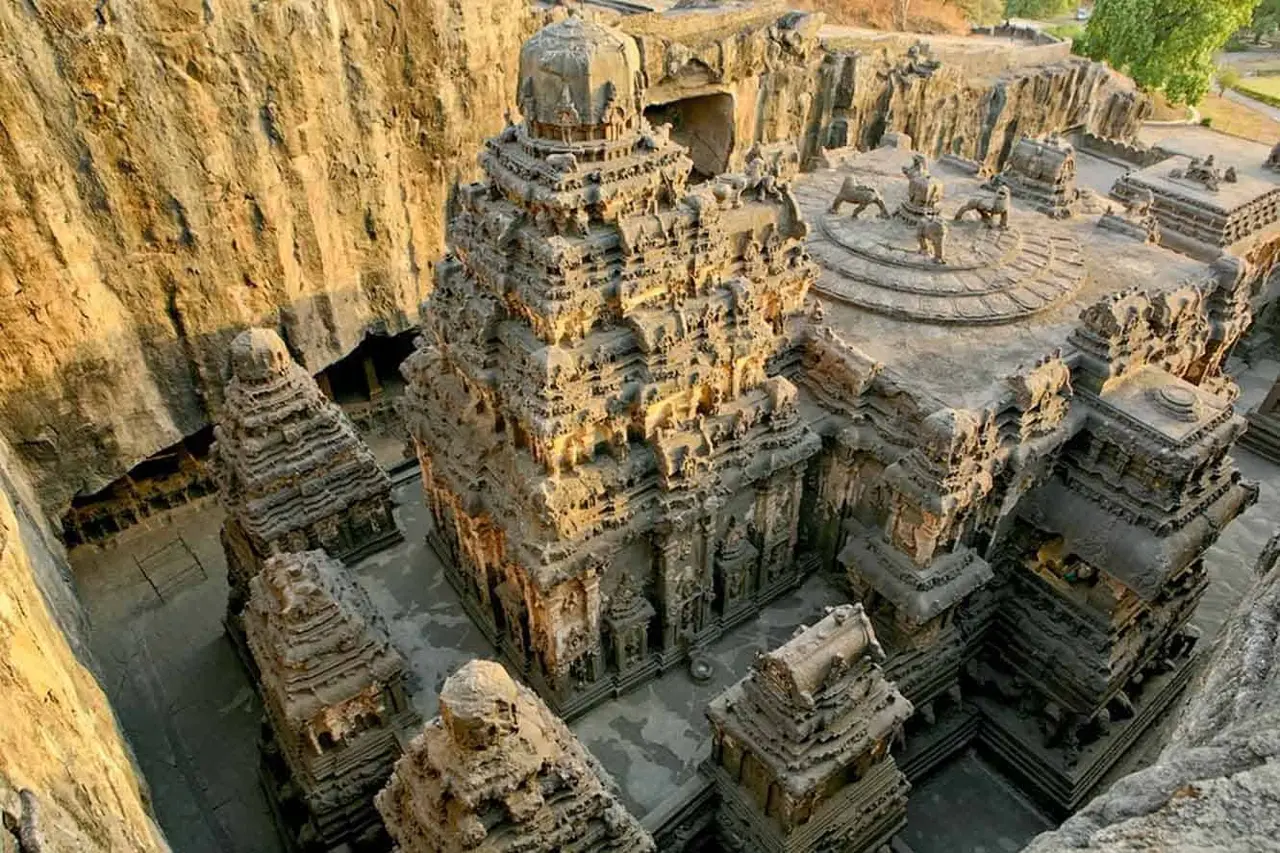
YouTube Video Here: https://www.youtube.com/embed/B2Jl4HNDixc?feature=oembed&enablejsapi=1 Thousands of years ago, the builders of the temples and caves of Ellora demonstrated extremely advanced c
YouTube Video Here: https://www.youtube.com/embed/B2Jl4HNDixc?feature=oembed&enablejsapi=1
Thousands of years ago, the builders of the temples and caves of Ellora demonstrated extremely advanced construction and engineering skills. One of the greatest mysteries is how and when. But perhaps the even greater question is how ancient mankind managed to do this using only hammers, chisels, and picks, thousands of years ago.
How the ancients constructed some of the most incredible ancient monuments we see today remains one of the greatest archaeological mysteries of the 21st century. Not only is it a mystery how ancient mankind managed to create The Kailasa temple –which is one of the largest rock-cut ancient Hindu temples on the planet-- but how ancient cultures in South and Central America managed to quarry, transport and place giant boulders is something, not even engineers today cannot imagine.
Archaeologists are said to have confirmed that over 400,000 tons of rock had to be scooped out, which would have taken not years, but centuries of human labor. Historians have no record of such a monstrous task, and they think that it was built in less than 18 years. (Source)
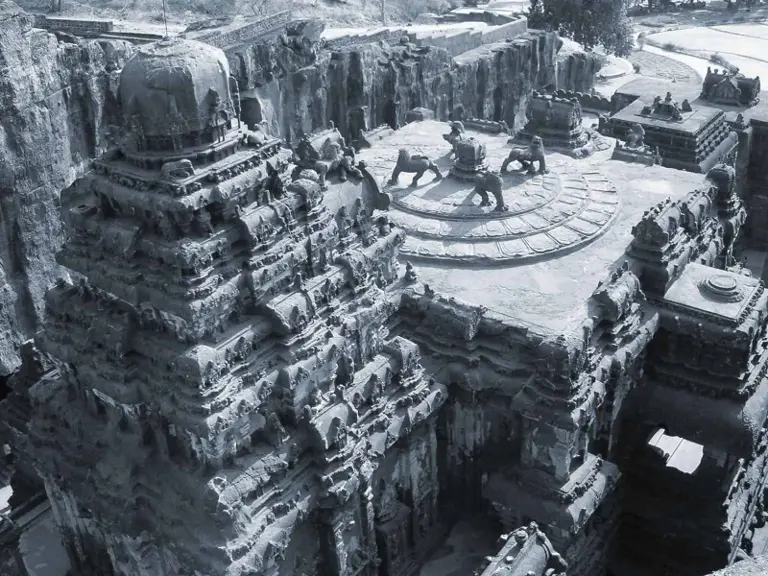
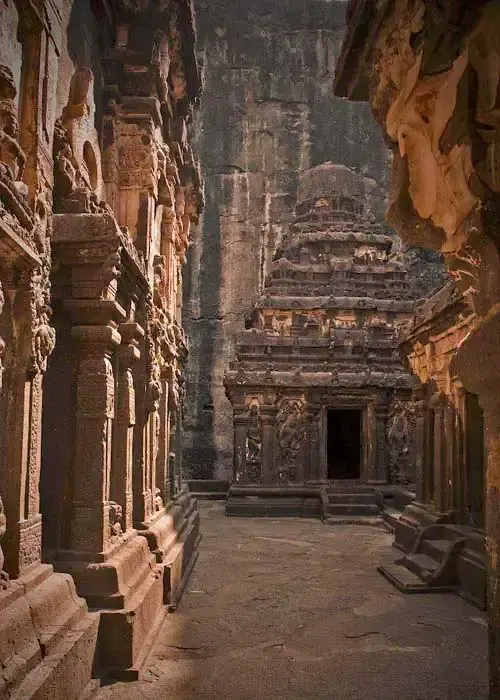
The Kailasa temple in Ellora, Maharashtra, India is a MEGALITH carved out of a SINGLE rock. It is considered as one of the most remarkable cave temples in India, mostly because of its humongous size, architecture and sculptural implementations.

Interestingly, the Kailasa is just one of the 34 monasteries and temples which extend over an area of 2 kilometers. The temples were dug side by side in the basalt cliff at Ellora. The temple itself was built out of a single rock, 164 feet deep, 109 feet wide, and 98 feet high, making it ONE of the BIGGEST MONOLITHIC structures on the planet, carved out of a single rock.
It is believed that the original builders of the Kailasa temple used a vertical excavation method. They started at the top of the original boulders and worked their way downward carving out one of the most fascinating ancient temples on the planet.
The temples are said to have been sculptured by a number of different cultures, from Hindus, Jains, and Buddhists. According to mainstream scholars, the earliest caves were believed to have been carved around 300 BC. However, most of the work was done in the period from the IV to the IX Century AD.
But not everyone agrees when it comes to the age of the ancient temples.
According to H.P. Blavatsky, many of these ancient temples date back much longer than what scholars today believe.
M.K. Dhavalikar, a notable Indian historian, and archaeologist, author of the book 'Ellora', suggests the shrines and the Kailasa temple were not excavated at the same time but are the result of a construction process that belongs to a number of different periods.
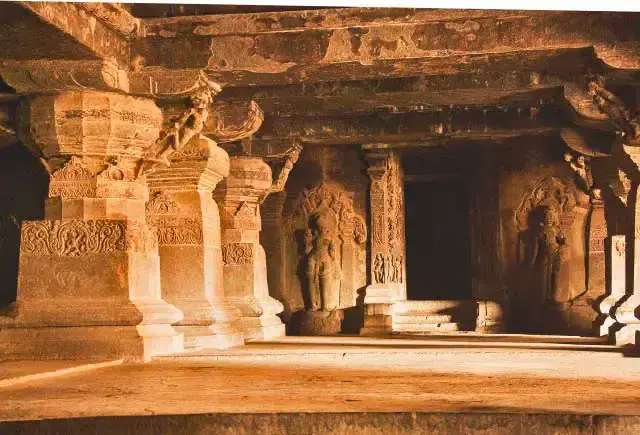
There is a perforated window in the west wall [of cave 15, a Hindu cave] on which is engraved a Sanskrit inscription in the Brahmi script of the eighth century. It is, however, incomplete and much of it has been damaged due to weathering. It gives the genealogy of the Rashtrakuta dynasty, from the founder Dantivarman (c. 600-30) and records the visit of Dantidurga (752-7) to the cave. It can, therefore, be placed in the middle of the eighth century. — Ellora, pp. 36-7 *Ellora, M. K. Dhavalikar, 2003, p. 7. (Source)
“This, of course, only proves that the caves existed in the 8th century and were engraved at that time with this inscription. Again, “There were inscriptions on pillars [in cave 33, a Jain cave] which are now mostly worn; a few letters that have survived suggest that the cave may have been built at around the ninth century” (ibid., p. 96). (Source)
But there are different theories about this fascinating ancient complex. Many Hindu experts agree that not much is known about the building process of the temple and its builders.
Here we have a few images that are worth a million words, enjoy.

Images remain copyright of their respective owners.
 Ancient Technology
Ancient Egyptian technology: a propeller that is thousands of years old?
Some believe that this is one of the best pieces of evidence suggesting that ancient Egyptians had knowledge and technology far beyond our own. According to ancient astronaut theorists, this object pr
 Ancient Technology
Ancient Power Sources of the Gods: Advanced technology and our ancestors
YouTube Video Here: https://www.youtube.com/embed/UfFRFPJbsHM?feature=oembed&enablejsapi=1 What sounds crazier, The Egyptian Pyramids producing wireless energy? Or transporting stone blocks that w
 Ancient Technology
The ancient Egyptians may have used infrasound to create altered states of consciousness in the pyramids
YouTube Video Here: https://www.youtube.com/embed/gL6jwZNtVVk?feature=oembed&enablejsapi=1 The Egyptian pyramids are miracles of construction and scientific achievement, which is even more amazing