
Among the numerous ancient texts, manuscripts and scrolls that completely disagree with mainstream history –or at least offer a complementary view— we find the ancient Sumerian King list which accordi
Among the numerous ancient texts, manuscripts and scrolls that completely disagree with mainstream history –or at least offer a complementary view— we find the ancient Sumerian King list which according to many is one of the most mysterious and important ancient texts ever discovered on Earth.
Why? Because it suggests that the ancient rulers had implausible lengthy reigns:
"...Alulim became king; he ruled for 28800 years. Alaljar ruled for 36000 years. 2 kings; they ruled for 64800 years. Then Eridug fell and the kingship was taken to Bad-tibira. In Bad-tibira, En-men-lu-ana ruled for 43200 years..."
This ancient text describes in great detail a time when Earth was ruled by beings referred to as 'Gods' for thousands of years.
The list composed in Ancient Sumerian offers details about numerous generations of kings that ruled over the land of ancient Sumer. The list not only offers us their names, but it details their supposed length and location of Kingship.
In this article, we bring you 15 mind-boggling facts about the Ancient Sumerian King list.
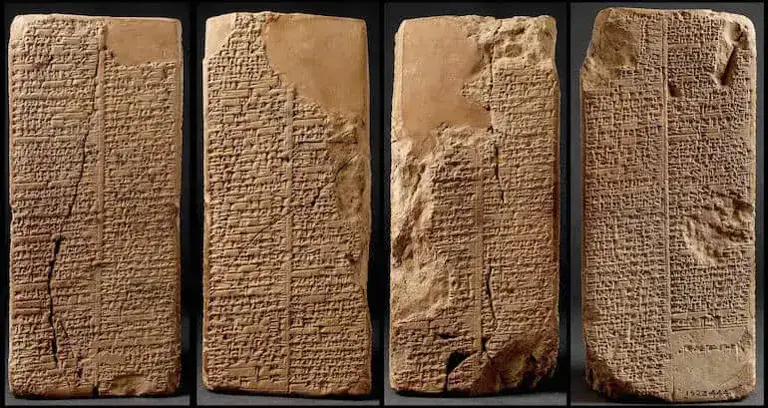
The Ancient Sumerian king list provides a comprehensive list of the Sumerian Kings from the beginning, before the great flood, and the 10 kings who lived before the Flood who lived for thousands of years.
The first part of the Sumerian King List reads: “…After the kingship descended from heaven, the kingship was in Eridug. In Eridug, Alulim became king; he ruled for 28800 years. Alaljar ruled for 36000 years. 2 kings; they ruled for 64800 years. Then Eridug fell and the kingship was taken to Bad-tibira. In Bad-tibira, En-men-lu-ana ruled for 43200 years. En-men-gal-ana ruled for 28800 years. Dumuzid, the shepherd, ruled for 36000 years. 3 kings; they ruled for 108000 years…”
Fragments of the Sumerian Kind list were discovered in 1900’s by German-American researcher Hermann Hilprecht at Nippur.
After 1906, 18 other lists have been discovered dating from the second half of the Isin dynasty.
There are more than a dozen of copies of Sumerian King Lists, found in Babylon, Susa, and Assyria, and the Royal Library of Nineveh from the VII century BC.
The best-preserved specimen of the Sumerian King List is called the Weld-Blundell Prism, which is a clay, cuneiform inscribed vertical prism housed in the Ashmolean Museum.
Mainstream scholars suggest that the Ancient Sumerian King list is a mixture of prehistorical and mythological accounts.
Scholars are unable to explain why the unique list blends mythical pre-dynastic rulers with historical rulers.
The list is only partially accepted in the academic community. Experts claim that some of the accounts are myths while other are genuine.
The Sumerian King list suggests that Ancient kings had implausible lengthy reigns, which has led many to conclude its not real.
Experts argue that the antediluvian reigns described in the Sumerian King list were measured in Sumerian numerical units known as sars (units of 3,600), need (units of 600), and sosses (units of 60).
Researchers have mixed feelings about the Sumerian King list. The mind-boggling lengthy reigns described in the SumerianKing list has led to the creation of countless theories trying to explain the implausible lengthy reigns.
Some scholars argue that the years of reign described in the Sumerian King list were not actual years, but are a reflection of the importance of the king.
The more years the king ‘ruled’ the more important He was to history in the eyes of mortal humans.
The only problem with this theory is that no one can explain why the period of reign was switched to realistic numbers afterward.
Featured image by Julian-Faylona
 Sumer & the Anunnaki
Civilizations before history: Ancient Sumer and the Sumerian King list
There have been numerous discoveries that seem to disagree with history as we know it. Ancient civilizations that predate our times are known to have existed across the globe, but who were they and we
 Sumer & the Anunnaki
The language and writing system of ancient Sumeria
The Sumerian language is considered to be a language isolated in linguistics that does not seem to belong to any known linguistic form. Researchers have studied the ancient Sumerian language and tried
 Sumer & the Anunnaki
An Ancient Tablet's Clue to Immortality Sounds Like One Scientists Study Now
A strange alien-looking creature spreading across the world's oceans is practically immortal. It's Turritopsis dohrnii, the "immortal jellyfish" that can avoid death when stressed. In a manner that's