
YouTube Video Here: https://www.youtube.com/embed/KA0VWfJEn9U?feature=oembed&enablejsapi=1 While we know a great deal about the Vikings thanks to books, documentaries, and other sources of informa
YouTube Video Here: https://www.youtube.com/embed/KA0VWfJEn9U?feature=oembed&enablejsapi=1
While we know a great deal about the Vikings thanks to books, documentaries, and other sources of information, what do we really know about how these ancient people lived when they weren't out conquering other lands?
Sadly, the answer is that we don't know much at all regarding the home life of Vikings.
But that's changing thanks to a groundbreaking new book from Marianne Hem Eriksen entitled Architecture, Society and Ritual in the Viking Age. Doors, Dwellings, and Domestic Space.
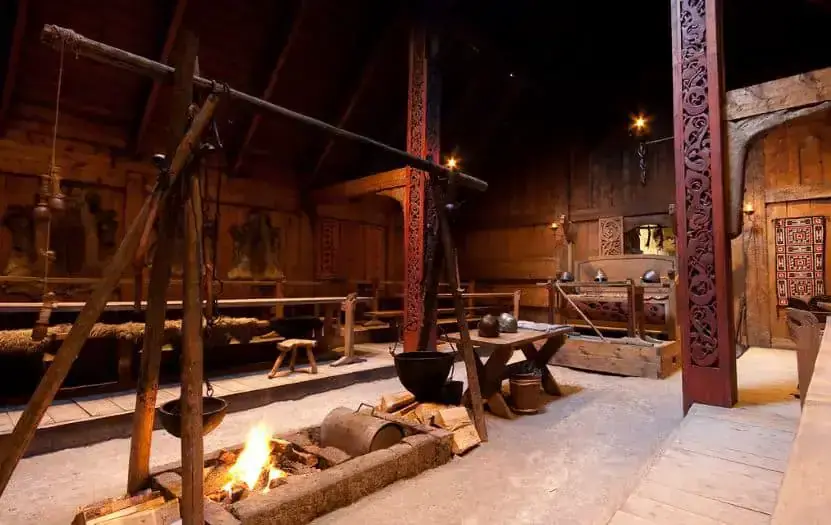
[caption id="attachment_42913" align="alignnone" width="1024"] The interior of a Viking house (Via Jon Olav Eikenes/Flickr)[/caption]
First of all, it should be noted that the "average" Viking household was a far cry from what we think of when we think of how people live now, Eriksen writes in an article she penned for The Conversation:
"The Viking household, while varied, did not conform to the idealized nuclear family of Western modernity. The largest households could be composed of a couple, concubines, subordinates, farmhands and warriors, animals, itinerant workers, guests, and a range of ‘mine, yours, and our’ children. Although they lived under one roof, everyday tasks and the architecture itself created thresholds between groups and made people different from each other."
[caption id="attachment_42915" align="aligncenter" width="610"]
 A reconstructed Viking chieftain's longhouse (Via Wikimedia Commons)[/caption]
And it wasn't just the living who inhabited a Viking house.
Archaeological finds suggest that the dead also had an important place and role in the Viking home. At times, human bones were even embedded into the house. That included dead infants who were buried in hearths and postholes:
"It must have been meaningful for people to place body parts of their dead under the threshold or in the postholes of the longhouse, or to inter the dead in the house when they abandoned the settlement."There is a clear ambiguity to dwelling with the dead. On the one hand, people sometimes kept the dead close, embedding them in the living space. Infants and ancestors may have helped protect the house, anchor it in local histories, or empower its residents.
"If they became malevolent, they could threaten the household – and so the threshold to their world needed to be controlled."
Some Viking homes even contained what can best be called portals between the living and the dead. The most frequent location for such a portal was the threshold of the home.
[caption id="attachment_42917" align="aligncenter" width="610"] Excavation of Viking village in York via Flickr[/caption]
"Two written sources tell the narrative of a woman being lifted over a door to see into a different realm. One is an eyewitness account of a ship burial on the Volga River, where a slave woman is lifted above a freestanding portal (much like a doorframe). This allows her to speak with the dead chieftain."The other is an obscure text about a ritual gone wrong, where the lady of the house asks to be lifted “over hinges and door-beams, to see if she can save the sacrifice” — perhaps to see into another realm or into the future. The door could thus be a portal to other powers and beings . Perhaps for this reason, freestanding portals were sometimes erected at Viking burial grounds."
Archaeologists also found many objects that must have held some special significance to the Viking residents: Pots, knives, and iron rings.
The objects were usually buried in or near doorways, suggesting that they may have been used as talismans or artifacts imbued with magical powers that were believed to protect the house from powers on the outside.
Eriksen concludes her article with a reminder that while we do indeed have much knowledge about Vikings, there remains much we still need to learn:
"When the Vikings engaged with the wider world through raids, trade, and settlement, their understanding of the world was anchored in their everyday experience in the home from childhood onwards. The time is ripe to broaden the topics we associate with the Viking Age, and to discuss the unfamiliarity and strangeness, as well as the role of inequality, in this pivotal period of European history."
Tour a Viking turf house by watching this incredible video
Featured Image Via Joxean Koret/Flickr
 Archaeology & History
Unusual twin Viking boat graves discovered in Norway by archaeologists
YouTube Video Here: https://www.youtube.com/embed/x_7eHqWOrKA?feature=oembed&enablejsapi=1 Archaeologists made a fascinating find in Norway recently by uncovering not just one ancient Viking boat
 Archaeology & History
Did this hallucinogenic plant transform Viking warriors into the legendary Berserkers?
YouTube Video Here: https://www.youtube.com/embed/6Kf27uTGx80?feature=oembed&enablejsapi=1 The Norse Berserkers were legendary ferocious Viking warriors dating back to ninth-century Scandinavia th
 Archaeology & History
Mjolnir! Man Finds an Ancient Amulet of Thor’s Hammer in Iceland
A man exploring a Viking Age farmstead in the Icelandic highlands has found a unique, never-before-seen amulet representing Thor’s hammer Mjolnir. No other similar artifact has ever been discover