

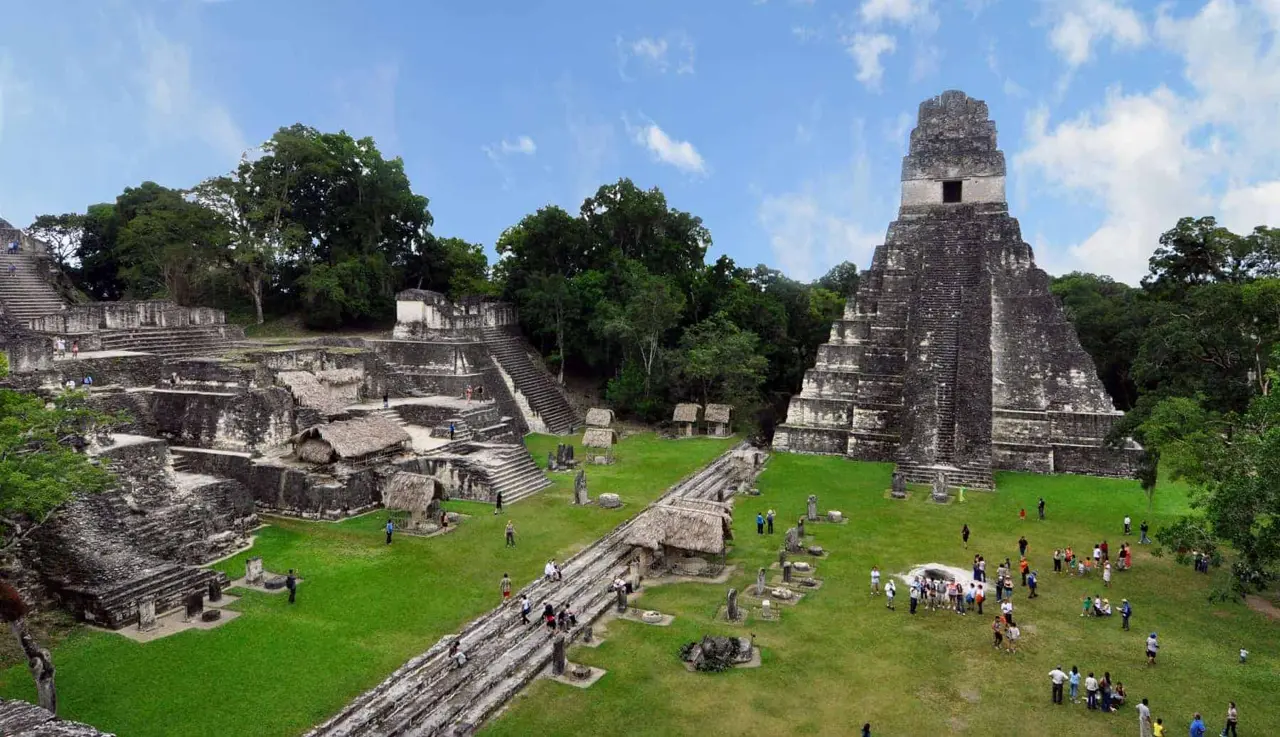
The ancient Maya were a Mesoamerican civilization that flourished in the jungles of present-day Mexico(south), Guatemala and Belize. This mysterious ancient civilization was one of the most important
The ancient Maya were a Mesoamerican civilization that flourished in the jungles of present-day Mexico(south), Guatemala and Belize. This mysterious ancient civilization was one of the most important ancient cultures to develop on our planet, noted for the Maya script, the only known developed writing system of the Pre-Columbian Americas.
The earliest inscriptions found of a Maya script and are identifiable Maya writing go back as far as the 3rd century BCE in San Bartolo, Guatemala. The Maya were incredible astronomers, engineers, and warriors.
The reason why the ancient Maya collapsed is still debatable, several theories have been proposed but scholars worldwide have a difficult time defining what exactly caused this great civilization to collapse. Most scholars seem to agree that a drought was the main reason the ancient Maya civilization collapsed, but deforestation, famine, and warfare are also possibilities that cannot be overruled at present.
Here we bring you reasons why the ancient Maya could have collapsed:
- Deforestation. Research by the Arizona State University showed that rainfall in combination with large-scale deforestation proved to be a cataclysmic combination for this ancient civilization. Since the Maya burned and cut down timber very fast very big, deforestation levels were high; the Maya used wood for construction purposes, as their cities expanded, the demand for timber increased. Research estimates that the ancient Maya used around twenty pieces of wood to obtain a square meter of cityscape. The Maya also cut down trees to make room for crop plantations such as corn. As the population increased, the necessity for crops increased, accelerating deforestation in the region. Because of this rainfall and clouds decreased in the region adding to the severity of the extreme droughts already present.
- Famine. Even though the ancient Maya civilization were skilled agricultural workers planting corn and beans among other vegetables, some scholars suggest that the ancient society could not meet the demand of rising population in their major cities. Coastal cities relied on fishing while maintaining an agricultural development of their most precious item; corn. Not only did the Maya produce corn, historical studies suggest that manioc, sunflower seeds, cotton, and other crops have been cultivated in the ancient Maya society as well. Even though they were skilled in agriculture, some scholars suggest that together with accelerated deforestation, caused by their expansive agricultural fields, caused a combination of issues that significantly reduced the amount of food produced, leading towards a famine that practically brought the ancient Maya to their knees.
- Drought. Recent research seems to support this theory like never before; studies reveal that the Maya civilization collapsed due to a century-long drought. The investigation that took place at the famous Blue Hole in Belize provided scientists with enough research to conclude that an extremely long drought took place somewhere around 800 A.D. and 900 A.D. Several deciphered glyphs found at various Maya sites seem to back this theory up as the Maya culture had a constant grow but collapsed silently after 904 A.D. Today scholars believe they have enough evidence to conclude that the Maya civilization was brought to its knees because of an extreme drought combined with other factors such as deforestation and overpopulation in some areas.
Image credit: Shutterstock
 Mesoamerica & the Andes
The Mystery Of King Pakal: Did he lift off to the stars?
We've all heard about the ancient alien theory, some of us enjoyed the famous series on TV while others tried constantly to debunk every single point of it. Like everything in life, there are cons and
 Mesoamerica & the Andes
Why Do Ancient Maya Temples Resemble In Great Detail Ancient Indonesian Temples?
Located on the western slope of Mount Lawu we can find the Javanese-Hindu temple of Sukuh believed to date back to the 15th century and a fifth-century Javanese-Hindu temple called the Cetho temple. T
 Mesoamerica & the Andes
20 Facts about the Ancient Maya Civilization
[caption id="attachment_8819" align="aligncenter" width="960"] Chichen Itza in the Yucatan Peninsula. Image Credit: Wikimedia commons.[/caption] The ancient Maya civilization was without a doubt, one