
YouTube Video Here: https://www.youtube.com/embed/quUtlWTB_dc?feature=oembed&enablejsapi=1 If you travel to the Giza plateau, you should know that there are many incredible things to explore, in a
YouTube Video Here: https://www.youtube.com/embed/quUtlWTB_dc?feature=oembed&enablejsapi=1
If you travel to the Giza plateau, you should know that there are many incredible things to explore, in addition to the three main pyramids.
One such fantastic feature is the so-called Tomb of Osiris, or commonly referred to as the Osiris Shaft.
Located beneath the stone causeway of the Pyramid of Khafre, this enigmatic tomb is a mysterious structure composed of various intricately carved levels beneath the surface.
Despite the fact that its existence has been known for a few years, it wasn't until recently that the structure was adequately excavated and documented.
In ancient times, the shaft was used by people as a swimming hole since it was filled with water.
Selim Hassan and his team were one of the first to explore the shaft in the 1930's, but it wasn't until 1999 when the structure was fully excavated by Zahi Hawass. By 1999 the water levels at the Giza plateau had lowered to the point that a detailed excavation was possible.
Here is Selim Hassan's description of the Osiris Shaft:
Selim Hassan’s 1933-34 excavations report for Giza.
"Upon the surface of the causeway, they first built a platform in the shape of a mastaba, using stones taken from the ruins of the covered corridor of the causeway. In the centre of this superstructure, they sank a shaft, which passed through the roof and floor of the subway running under the causeway to a depth of about 9.00 m. At the bottom of this shaft is a rectangular chamber, in the floor of the eastern side of which is another shaft. This descends about 14.00 m. and terminates in a spacious hall surrounded by seven burial-chambers, in each of which is a sarcophagus. Two of these sarcophagi, which are of basalt and are monolithic, are so enormous that at first, we wondered if they contained the bodies of sacred bulls."
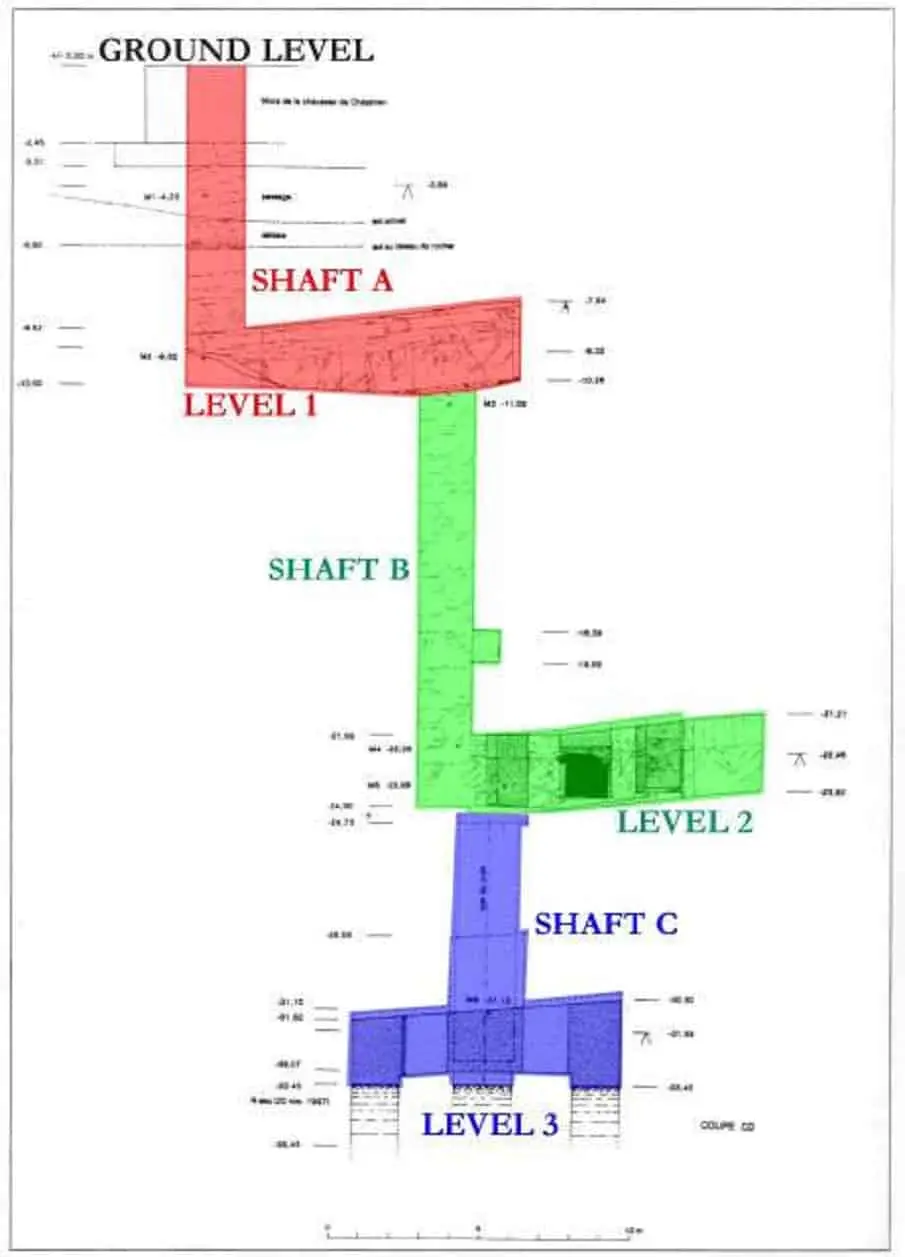
It was revealed that the shaft is composed of three different levels.
The first level was found to be empty.
The second level is a tunnel that leads into a room with six other chambers carved out of the stone walls. Inside these chambers, researchers have recovered pottery sherds, ceramic beads, and ushabtis (small servant figurines).
Furthermore, basalt sarcophagi were found in Chambers C, D, and G; badly decomposed skeletal remains were found in the sarcophagi in Chambers C and G. Based on stylistic grounds the artifacts, sarcophagi included, date to Dynasty 26 (ibid: 386-87).
 An overview of the Osiris Shaft.
In the lowest chamber of the Osiris shaft, some 30 meters below the surface lies a mystery described by Herodotus, which was written off as a myth by mainstream scholars.
However, it turned out that Herodotus was right all along, and mainstream scholars were wrong.
The lowest chamber of the shaft is a sort of subterranean hall, and inside it lies a sarcophagus, perfectly preserved and empty. The third level of the Osiris Shaft is found to be more complex regarding design and architecture.
The most important discovery made in the third level of the Osiris Shaft was red-polished pottery, containing traces of white paint. Experts managed to date back the pottery remains to the 6thy dynasty, from the end of the Old Kingdom.
This means that the pottery recovered in the third level is, in fact, the oldest possible datable material in the entire complex.
Based on research and archeological evidence recovered throughout the years, the Osiris Shaft is believed to date originally from the Old Kingdom, more precisely to the Sixth Dynasty (2355-2195 BCE).
The Osiris shaft was opened to the public for the first time in 2017.
Recently, author and researcher Brien Foerster explored the Osiris Shaft.
The result?
A magnificent insight into the mysterious shaft proving that despite the fact that we know a lot about ancient Egypt, there are many details we have still not uncovered.
Check out the video:
Brien Foerster and his team will return to the Giya plateau in April 2019. For more information check this out.
Zahi Hawass’s essay about the Osiris Shaft can be downloaded from this link: The Discovery of the Osiris Shaft at Giza.
 Ancient Egypt
Evidence of Ancient Advanced Technology: The Great Pyramid of Giza
Ancient Egyptian History has captured the interest of millions of people around the world. There is something about the land of the Pharaohs that makes it magical and profound at the same time. The Py
 Ancient Egypt
An Electromagnetic Sphere was located on top of the Great Pyramid of Giza
What do Nikola Tesla and the Great Pyramid of Giza have in common? Well more than you would have thought actually. Is it possible that the Great Pyramid of Giza was in fact a GIANT energy plant as som
 Ancient Egypt
Why did the Ancient Egyptians stop building pyramids?
The Egyptians stopped building their most prominent structures with the beginning of the New Kingdom, but why? What was the cause that led to the abandonment of the most incredible ancient structures