
YouTube Video Here: https://www.youtube.com/embed/qi-Q1Vr7B8A?feature=oembed&enablejsapi=1 The ancient texts of Mesopotamia are undergoing a revival, as ancient astronaut theorists look at them fo
YouTube Video Here: https://www.youtube.com/embed/qi-Q1Vr7B8A?feature=oembed&enablejsapi=1
The ancient texts of Mesopotamia are undergoing a revival, as ancient astronaut theorists look at them for clues about our true origins. While the texts are dismissed as mere mythology by mainstream scholars, these theorists are looking at the words with fresh eyes and open minds.
Perhaps there is more to these texts that scholars brushed aside too readily? Meanwhile, similar texts are viewed as unquestionable and Holy by millions of religious people today. As in the older stories, sometimes those texts feature stories of supernatural beings from other worlds, monstrous people and animals, not to mention advanced technology.
It's fascinating to look at the intersections of ancient Mesopotamia, Egypt, and the Bible. The stories overlap, and when they do they are sometimes considered Apocrypha, or “hidden."
Previously, we looked at the story of 4 Baruch. It's one such hidden story of an eagle messenger that could resurrect the dead. The story also features a clear case of time dilation similar to the famous American folklore of Rip Van Winkle.
Now, we'll look at another story connected to "the most prestigious god of the Mesopotamian pantheon," Marduk, and his dragon. Now this story, also considered apocryphal, is "Bel and the Dragon" in the extended Book of Daniel. The story considered apocryphal in the Protestant Bible but lived on in the King James Bible.
 Marduk and his dragon, Mušḫuššu, from a Babylonian cylinder seal, via Wikimedia Commons, public domain
Who is Bel?
The Bible story features an idol of Bel, or "lord" whose name in ancient Mesopotamia was Marduk, son of the god of wisdom Enki. This name should be familiar. Why? He's associated with Zeus by the Greeks. His temple may be quite famous in another Bible story. (See below)
Marduk, who was later known as Bel, was worshipped almost in a monotheistic sense in Mesopotamia. Then, invading armies would do their best to erase all traces of him from history. His statue became so important that it was repeatedly stolen and restored to ancient Babylon.
"Marduk was regarded as the creator of the heavens and earth, co-creator with Enki of human beings, and originator of divine order following his victory over the forces of chaos led by the goddess Tiamat. Once he legitimized his rule, he conferred upon the other gods their various duties and responsibilities and organized both the world and the netherworld."
According to the Ancient History Encyclopedia:
"Marduk was the patron god of Babylon, the Babylonian king of the gods, who presided over justice, compassion, healing, regeneration, magic, and fairness, although he is also sometimes referenced as a storm god and agricultural deity. His temple, the famous ziggurat described by Herodotus, is considered the model for the biblical Tower of Babel."
"The Greeks associated him with Zeus and the Romans with Jupiter. He is depicted as a human in royal robes, carrying a snake-dragon and a spade. Marduk seems to have originated from a local deity known as Asarluhi, a farmer's god symbolized by the spade, known as a marru, which continued as part of his iconography. Marduk's name, however, though linked to the marru, translates as 'bull-calf,' although he was commonly referred to simply as Bel (Lord). Far from the local deity he sprang from, Marduk would become the most prestigious god of the Mesopotamian pantheon."
Bel's dragon
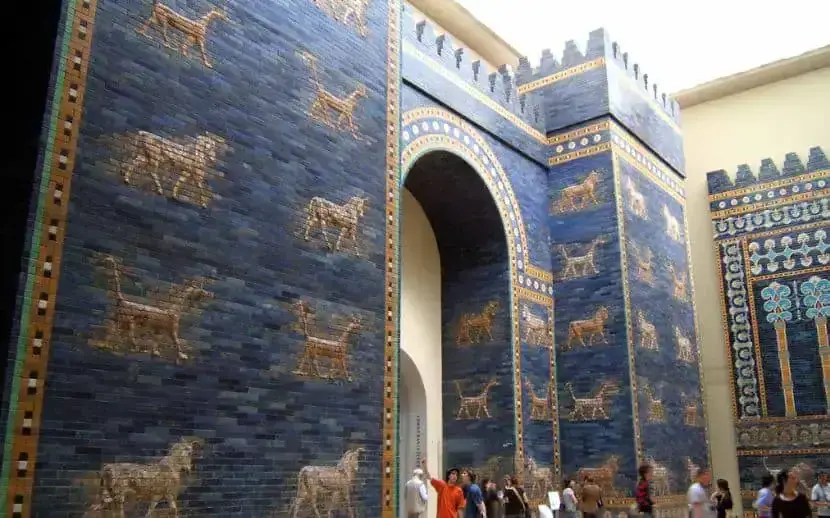
Marduk's son, Nabu, became "the most important god of the Babylonians," and was associated with the Egyptian god, Thoth. Both Marduk and Nabu were associated with a snake-dragon known as the Mushussu Dragon. You can see the 'dragon' on the famous reconstructed Ishtar Gate initially constructed by the Babylonian King Nebuchadnezzar II circa 575 BCE. It initially was considered one of the Seven Wonders of the World along with the King's Hanging Gardens of Babylon, which no longer exists.
 Ishtar Gate in the Pergamon Berlin Museum via Wikimedia Commons (CC BY 2.0)
 The Mushussu Dragon via Wikimedia Commons
The Mushussu Dragon was alive in the story from the Bible, while Bel was a statue considered protective and of great importance. The hybrid dragon was not as we would expect a dragon to look. It has talons of an eagle, lion-like forelimbs, a long neck and tail, a horned head, and a snake-like tongue, and a crest.
The dragon wasn't like the fire-breathing kind we know from the movies but shared much in common with dragons from other ancient stories around the world. Some cryptozoologists suggest the dragon from this Bible story was a real-life creature, known as the now-extinct Sivatherium.
These strange creatures were an extinct genus of enormous giraffids that ranged throughout Africa to the Indian subcontinent that may have still been around until 8,000 years ago. The species seems to be a subject of cave paintings in Saharan Africa, and when you see what it looked like, it does look like Marduk's dragon. (see video below)
 Sivatherium by via Wikimedia Commons CC BY 3.0
See much more about the fascinating Silvatherium from the Extinction Blog below:
YouTube Video Here: https://www.youtube.com/watch?v=PKxQGe98UMs
Bel and the Dragon
What happened to the dragon in the Bible story? Well, nothing good, that's for sure. Daniel decides to kill it in a very peculiar way. First, Daniel convinces the Persian King (who had taken over) that worshipping Bel was wrong as idol worship. Bel's followers were secretly consuming food left for the statue, and this was so egregious that the King slaughtered them for it and destroyed the statue of Bel.
See a cartoon version of Bel and the Dragon with the idol of Bel as a head from Easter Island (!).
The news so distressed the people of Babylon that Daniel was thrown into a den of lions to die, which as you know he miraculously doesn't. The story becomes the familiar "Daniel in the Lions' Den."
Today, the Bible tells the little-known story of the 'heroic' slaying of a seemingly harmless dragon, and the moral of the story that worshipping Bel was not the true religion. That narrative continues today, but in looking back, we see the ancient stories through a modern lens and with renewed interest. Instead of slaying the proverbial dragon, maybe it's time to take a closer look?
In the second part of the video, we get to the dragon, which was not an idol but a real biblical creature -at least until Daniel was done with him.
YouTube Video Here: https://www.youtube.com/watch?v=MjwT7PP5sfQ
Featured image: Dragon of Marduk by Kent Wang via Flickr (CC BY-SA 2.0) with Sivatherium by via Wikimedia Commons CC BY 3.0
 Sumer & the Anunnaki
New study reveals what brought down the powerful Assyrian empire
For 1,400 years, the ancient Assyrian empire dominated the Middle East ruling an area stretching from Turkey to Egypt and east to Iran through what is today Northern Saudi Arabia and Iraq. And then it
 Sumer & the Anunnaki
Ancient cuneiform tablets prove historically accurate in regards to possible threat to Earth
YouTube Video Here: https://www.youtube.com/embed/Rx-5dCXx1SI?feature=oembed&enablejsapi=1 Some 3,000 years ago, astrologers working for the king of the Assyrian empire kept a close eye on the ski
 Sumer & the Anunnaki
Priceless looted artifacts and tablets from Mesopotamia are slowly finding their way back home
YouTube Video Here: https://www.youtube.com/embed/2qiZpndjg6Y?feature=oembed&enablejsapi=1 When we examine the ancient texts of Mesopotamia and Sumer, we are talking about the location of modern-d