

The Discovery Could Rewrite the Story of Human Evolution. A discovery of a set of stone tools from about 385,000 years ago has experts rethinking the history of technology and mankind. Either ancient
The Discovery Could Rewrite the Story of Human Evolution.
A discovery of a set of stone tools from about 385,000 years ago has experts rethinking the history of technology and mankind. Either ancient humans in India developed sophisticated technology on their own at the same time as their fellow 'hominid' in Africa, or modern humans left Africa much sooner than what is currently believed.
The enigmatic set of tools, discovered at Attirampakkam, an area to the south-east of India, is evidence of sophisticated technologies which according to experts should not have existed during that period in history.
Sophisticated blades chipped from chinks of quartz were created with a technique that according to scholars, arrived in India around 125,000 years ago.
However, the new set of tools date back 385,000 years.
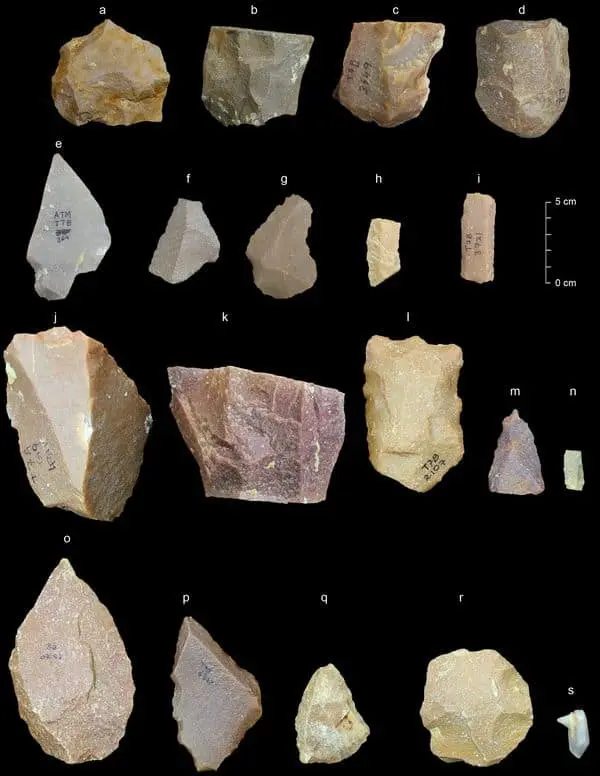
 Stone tools recovered at the Attirampakkam site in India from the middle paleolithic — including Levallois technology. Photo: Sharma Centre for Heritage Education, India.
How did they date the rock? Well, they did not. Using a method called infrared-stimulated luminescence, scientists pinpointed the last time that sediment grains were exposed to light. This way, researchers determined that the silts and grains which contains the tools date back some 385,000 years.
More than 7,200 tools were made with the technique called Levallois, a technology that has its roots in Africa and predates the arrival of modern humans in India.
This discovery, say, experts, is the earliest evidence of Levallois technology in India, and it effectively pushes back the timeline some 250,000 years.
Shanti Pappu, an archaeologist who leads the group of researchers at the Sharma Center for Heritage Education, said that, despite this discovery, it cannot be said exactly who made these tools.
"We cannot be sure who made the Attirampakkam tools, because we lack fossils [of hominids] for this period of time in India," Pappu explained.
On the other hand, Dr. Michael Petraglia, an archaeologist at the Max Planck Institute for the Science of Human History, who was not involved in the research, says that these tools are not enough evidence to say that African Homo sapiens traveled out of Africa earlier than previously thought.
"I just do not buy it," said Dr. Petraglia, a specialist in early human evolution in Asia, who did agree with another hypothesis put forward by Professor Pappu that non-modern humans lived in south-east India and developed this style of tools without the need of influences from foreign populations.
The new discovery points to the possibility that ancient humans in India developed the technology independently, which some researchers have previously suggested.
However, a more controversial theory is that modern humans migrated out of Africa much earlier than archaeological and paleontological evidence suggests.
Featured image: Levallois core from Attirampakkam, India, Credit: Sharma Centre for Heritage Education, India
Source: Nature
 Human Origins
Human Origins Story Remains Incomplete with Missing Ancestors
YouTube Video Here: https://www.youtube.com/embed/9VFxefR23EY?feature=oembed&enablejsapi=1
 Human Origins
Venomous Humans Could Evolve Due to Common Ancestor with Reptiles
YouTube Video Here: https://www.youtube.com/embed/nqoqxA8p_AM?feature=oembed&enablejsapi=1 Scientists have learned that venomous humans could one day become real. The headline elicits the r
 Human Origins
Study suggests Neanderthals were wiped out by a common childhood ear infection
YouTube Video Here: https://www.youtube.com/embed/xX2iv4SyNHg?feature=oembed&enablejsapi=1 Of all the possible ways the Neanderthals may have gone extinct, it turns out that it may have been as si