

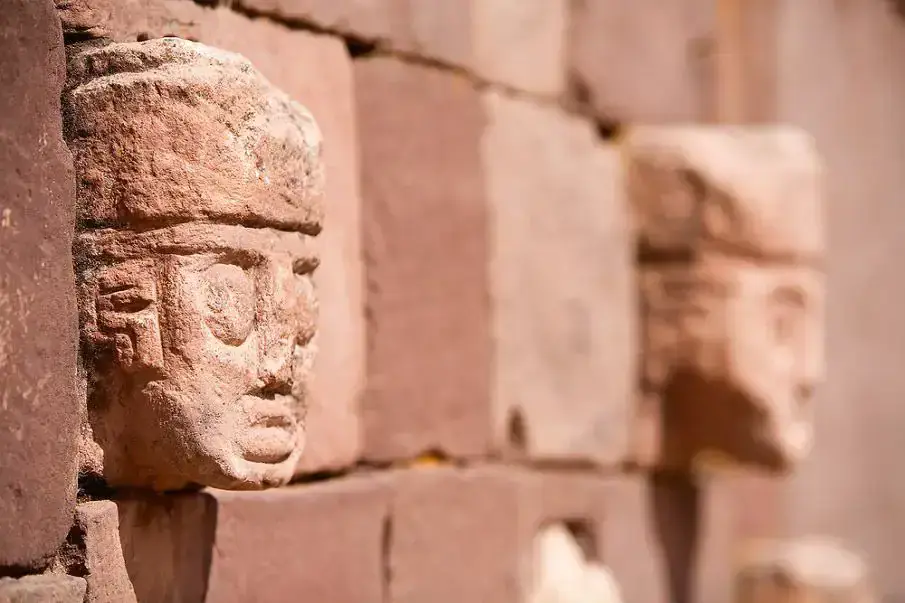
A group of archeologists from Bolivia has found an underground city dating back to pre-Inca times outside the ancient archaeological site of Tiwanaku , in the province of Ingavi, in the department of
A group of archeologists from Bolivia has found an underground city dating back to pre-Inca times outside the ancient archaeological site of Tiwanaku, in the province of Ingavi, in the department of La Paz, as reported by the Bolivian Ministry of Cultures and Tourism.
"With new data obtained with the help of modern technology, consisting of precision cameras that took pictures from the air and infrared surveys, was found a pre-Hispanic citadel outside the archaeological perimeter. There, we found an underground plaza and up to two platforms of what is considered a pyramid," wrote in a statement the Bolivian Ministry of Cultures and Tourism.
[caption id="attachment_26921" align="aligncenter" width="905"]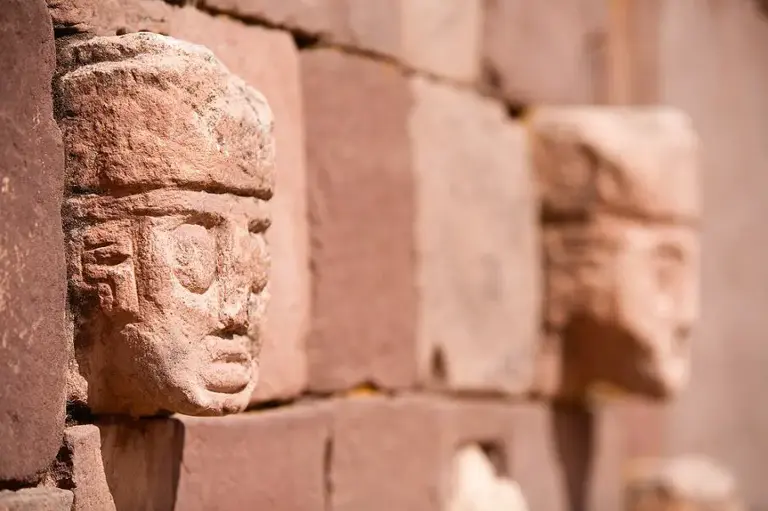 The wall of a hundred faces at Tiwanaku.[/caption]
The discovery took place within the framework of the preservation and conservation works of Tiwanaku, carried out in the area with the cooperation of scientists from Japan and UNESCO.
According to experts, the excavation could take up to 50 years to reveal that what is hidden beneath the surface.
https://twitter.com/CulturasBolivia/status/1024100960614981640
"Excavation drilling will be carried out in the southwest and north, with the aim of confirming or delegitimizing the data obtained," said Julio Condori, general director of the Center for Archaeological, Anthropological and Administration Research of Tiwanaku (Ciaat).
The ancient citadel of Tiwanaku, together with Puma Punku, are some of the most mysterious ancient sites in Bolivia. Home to stones and megaliths that defy logic, these two sites are a treasure trove for archeologists.
[caption id="attachment_6947" align="aligncenter" width="1024"] The Gateway of the Sun from the Tiwanaku civilization in Bolivia.[/caption]
It is one of the main tourist destinations in Bolivia. Its main attractions are the Temples of Kalasasaya and Puma Punku, the Puerta del Sol, the Pyramid of Akapana and a series of other gigantic monoliths that were erected thousands of years ago by a mysterious people.
It is believed that its builder civilization arose on the shores of Lake Titicaca in the year 1,580 B.C., and disappeared by 1200 AD. In 1945, Arthur Posnansky estimated that Tiwanaku dated to 15,000 BC based on his archaeoastronomical techniques.
It is suspected that climatic effects and pests decimated the population.
According to the experts, one of the oldest cultures in South America, the ancestor of the Aymaras and the Quechuas, called the area their home.
If researchers confirm the new discovery, it would force us to rethink the idea that Tiwanaku was only a ceremonial center and consider it was a massive ancient metropolis, divided by several large complexes.
 Mesoamerica & the Andes
The mysterious "Gate of the Gods" at Hayu Marca, Peru
An ancient legend speaks of a mysterious door which is located in the vicinity of Lake Titicaca. This door, will open one day and welcome the creator gods of all mankind. These gods will return in the
 Mesoamerica & the Andes
History changer: Researchers discover buried Pyramid at Tiahuanaco
The Government of Bolivia has announced the discovery of a unknown pyramid and the beginning of excavations at the ancient citadel of Tiahuanaco, after Ground penetrating radar tests discovered the py
 Mesoamerica & the Andes
Atlantis, Tiahuanaco and Puma Punku; Incredible Similarities
Atlantis in... Bolivia? According to many researchers Atlantis might have been located in the American Continent, and some believe that the Bolivian Andes region coincides with Plato's description of