

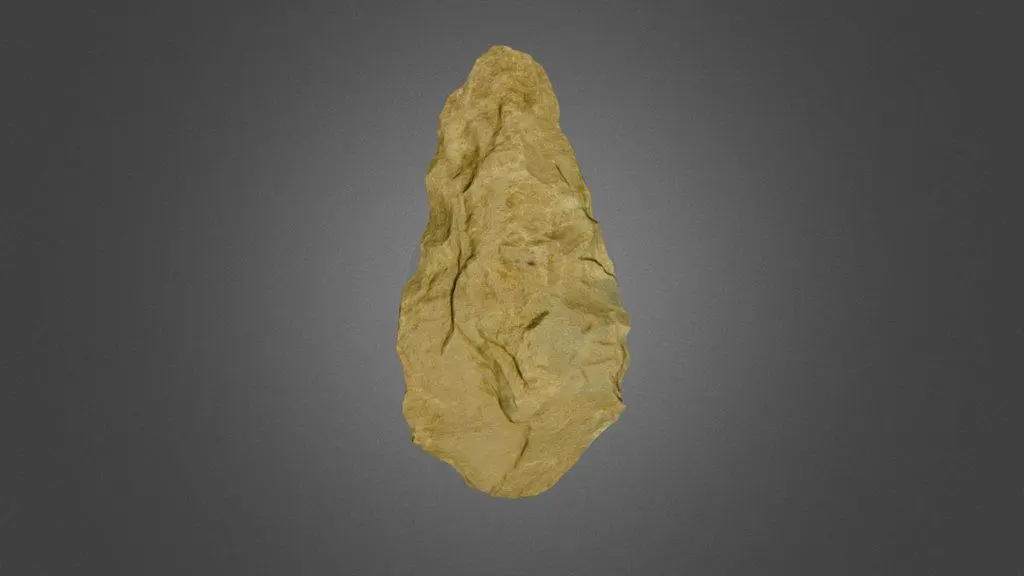
Researchers have uncovered 'giant' hand axes believed to date back between 200,000 and 300,000 years. It is believed the hand axes were used by a mysterious human ancestor to cut prey in prehistoric E
Researchers have uncovered 'giant' hand axes believed to date back between 200,000 and 300,000 years. It is believed the hand axes were used by a mysterious human ancestor to cut prey in prehistoric Europe, report experts.
The 'giant' tools were used by ancient man to process hard materials such as wood and carcasses and were discovered at an archaeological site at Proto Maior in Spain.
Furthermore, a recent study carried out on the giant hand axes, suggests that there may have been two species of ancient humans, who lived close to each other for long periods of time.
 Image Credit: Eduardo Mendez Quintas
One group used technologies recently imported from Africa, while the others were long-standing residents.
In Porto Maior, located in Galicia, a group of archaeologists, led by experts from the National Center for Human Evolution Research, have found an important repository of large tools dating back nearly 300,000 years.
The tools have a distinctive style known as Acheulian, which is seen much more frequently in Africa and the Middle East than in Europe.
The nature of the finding suggests that humans may have used these tools to cross the Mediterranean 300,000 years ago, but we have no idea how.
The conclusions, recently published in the journal Scientific Reports, point out that although similar tools had already been found in southwestern Europe, they had never been found in this amount. Experts have recovered a total of 159 pieces, with a weight of 118 kilograms.
The pieces are larger and heavier than those found in other parts of Europe, while they are consistent with those of other continents.
'Porto Maior introduces further complexity to this overlapping technological pattern, and suggests that distinct early human populations of different geographical origins coexisted during the Middle Pleistocene (between 773,000 and 125,000 years ago)', researchers, led by Dr. Martina Demuro, a research fellow at the University of Adelaide wrote in the Conversation.
To explain this finding, two theories are currently considered by experts.
The first involves an African population crossing the Mediterranean, while the second indicates an independent invention of a very similar style.
The defenders of the second theory call attention to the subtle differences between the European findings and those of Africa.
The authors of the study, on the other hand, are inclined towards the African option, arguing; "Any hypothetical reinvention of Acheulian technology in Europe would have occurred 1 million years after the appearance of Acheulean in Africa in a different environmental and technocultural context, and most likely by a human species that was very different from Homo ergaster, the species responsible for this technology."
"The discovery of Porto Maior is further evidence of the arrival of this technology from Africa, given the similarities that the site shares with deposits of African tools," conclude experts.
Featured image credit: The large tools are consistent with a culture known as Acheulean. Eduardo Mendez Quintas
 Human Origins
Human Origins Story Remains Incomplete with Missing Ancestors
YouTube Video Here: https://www.youtube.com/embed/9VFxefR23EY?feature=oembed&enablejsapi=1
 Human Origins
Venomous Humans Could Evolve Due to Common Ancestor with Reptiles
YouTube Video Here: https://www.youtube.com/embed/nqoqxA8p_AM?feature=oembed&enablejsapi=1 Scientists have learned that venomous humans could one day become real. The headline elicits the r
 Human Origins
Study suggests Neanderthals were wiped out by a common childhood ear infection
YouTube Video Here: https://www.youtube.com/embed/xX2iv4SyNHg?feature=oembed&enablejsapi=1 Of all the possible ways the Neanderthals may have gone extinct, it turns out that it may have been as si