
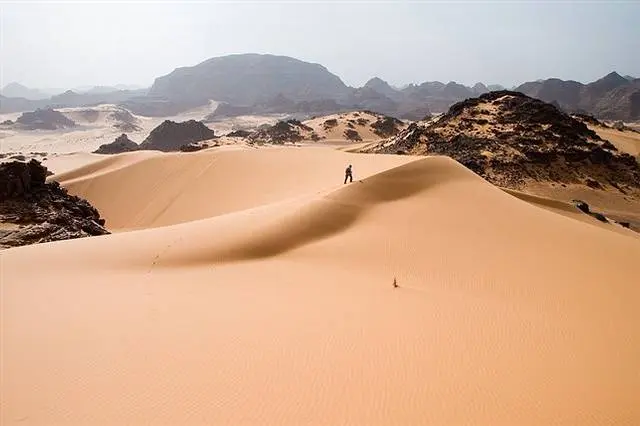
[caption id="attachment_22337" align="aligncenter" width="979"] Tadrart Acacus desert in western Libya, part of the Sahara. Image Credit: Wikipedia [/caption] So who 'created' the Sahara desert? The S
[caption id="attachment_22337" align="aligncenter" width="979"] Tadrart Acacus desert in western Libya, part of the Sahara. Image Credit: Wikipedia[/caption]
So who 'created' the Sahara desert?
The Sahara, the largest desert in the world, was not always the arid region we see today. More than 10,000 years ago, the gigantic expanse of dunes we see today was in fact a green meadow 'flooded' with lakes.
The drastic change in the landscape was often attributed to an alteration in Earth's orbit, but a new hypothesis suggests that it was humans who were behind the transition of the Sahara to the inhospitable desert we see today.
A new study concluded that our species played a fundamental role in the creation of the desert.
A new article published in Frontiers in Earth Science by archeologist David Wright of Seoul National University defies the conclusions of most of the studies to date that indicate changes in Earth's orbit or natural changes In vegetation as major driving forces that turned the Sahara into a massive desert.
To test his hypothesis, Wright reviewed the archaeological evidence documenting the first grazing occurrences throughout the sub-Saharan region and compared this to records showing the spread of scrub vegetation, an indicator of ecological change towards desert conditions.
According to reports, it all began some 8,000 years ago when African neolithic communities started experimenting with pastoral agriculture near the river Nile. This technique gradually moved westwards and as communities spread, they introduced large quantities of livestock and an increasing amount of vegetation was removed to graze and house them.
This massive change reduced the ground to scrub which left almost no protection from the sun's rays. This increased the amount of sunlight which was reflected off our planet's surface, which changed atmospheric conditions.
According to experts, this caused a reduction in monsoon rainfall which in turn led to further desertification and vegetation loss.
Throughout the years, this cycle eventually spread out ‘terraforming’ an area as big as the US into the desert we see today.
Much remains to be done to fill the gaps, but Wright believes there is a lot of information hidden beneath the surface: “There were lakes everywhere in the Sahara at this time, and they will have the records of the changing vegetation, " Dr. David Wright said in a statement.
"We need to drill down into these former lake beds to get the vegetation records, look at the archaeology, and see what people were doing there. It is very difficult to model the effect of vegetation on climate systems. It is our job as archaeologists and ecologists to go out and get the data, to help to make more sophisticated models."
Despite taking place several thousand years ago, the implications of humans who are responsible for environmental and climatic degradation are easy to see.
With approximately 15 percent of the world's population living in desert regions, Wright highlights the importance of the finding: "The implications of how we change ecological systems have a direct impact on whether humans can survive indefinitely in arid environments."
 Earth Mysteries
The Dyatlov Pass Incident: What Killed Nine Young Hikers at Dead Mountain?
Russia's Dyatlov Pass Incident is one of the creepiest, most mysterious true stories ever told. In January 1959, during the height of the Cold War, nine young Urals Polytechnic Institute s
 Earth Mysteries
Black Bird — The enduring Chernobyl mystery
YouTube Video Here: https://www.youtube.com/embed/kpusufJXL5M?feature=oembed&enablejsapi=1 The Chernobyl catastrophe remains a worst-case scenario for nuclear power. The incident with the Chernoby
 Earth Mysteries
18 Mysterious Satellite Images Spark Debate About Alien Symbols And Bases In Chinese Desert
They say the truth is out there. The surface of our planet is plagued by mysterious ancient structures which date back thousands—and some even tens of thousands—of years back. They are proof of incred