
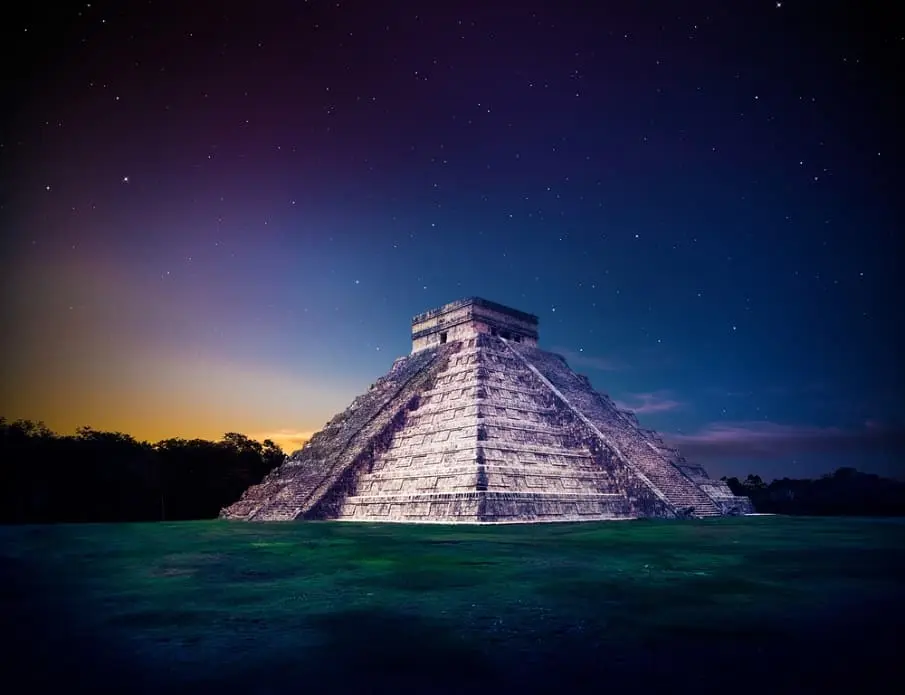
Archaeologists have made an incredible discovery after revealing a 'secret' passageway located beneath the ancient pyramid of Kukulkan in the ancient city of Chichen Itza in Mexico. The Mayan pyramid
Archaeologists have made an incredible discovery after revealing a 'secret' passageway located beneath the ancient pyramid of Kukulkan in the ancient city of Chichen Itza in Mexico.
The Mayan pyramid located in Chichen Itza is one of the most visited sites in modern-day Mexico.
Erected more than a thousand years ago, the stunning structure built by the long-lost civilization has been the subject of debate among experts, who have revealed a number of secrets hiding in the Pyramids interior.
Now, experts have found what appears to be a secret passageway leading to an underground chamber, or cave, filled with water beneath the 'El Castillo' Pyramid at Chichen Itza.
The cave, according to experts, is a cenote (a kind of flooded hole) that leads to the temple and could reveal the "sacred geography" of the place.
The theory is that there is a system of underground sumps interconnected around the pyramid at its cardinal points.
 The Pyramid of El Castillo holds many secrets. Image Credit: Shutterstock
The discovery was made by a team led by underwater archaeologist Guillermo de Anda, who used advanced imaging techniques, like ground penetrating lidar—a form of radar, to send electromagnetic signals through the walls and other architectural elements of the pyramid and its surroundings—and make a 3D model of the structures that make up the subsoil around the pyramid.
However, although there is certainty of the existence of the passage, the first explorations have not been made.
De Anda said in a statement to Milenio, that if the cenote was verified, it would "totally change" the vision we have of "the patterns of the Mayan settlement."
 This image shows the tunnel that leads to the interior of the Kukulcán pyramid at Chichen Itza. Image Credit: INAH
The discovery was made through a smaller burial chamber referred to as the Ossuary.
In an interview with El universal, Dr. De Anda said: "Through the Ossuary, we can enter the cave beneath the structure and there we found a blocked passageway, probably closed off by the ancient Mayans themselves. We will enter again and this time we will try to open it to see if the passageway leads us to the entrance of the cenote beneath the pyramid."
Unlike the European cosmogony that places the deities in heaven, Mayan spirituality believed that the Gods came from the underworld. The most sacred and alive was the earth, that is why formations such as caves and cenotes were so sacred because they were an access road to the inside of the earth, that is, leading to the presence of the gods," said Dr. James Brady from the California State University, Los Angeles.
 ERT-3D scans have revealed a smaller substructure within the walls of the Temple of Kukulkan. Image credit: UNAM
Dr. Brady is a worldwide pioneer in the study of the relations established by the Mayans between architecture and caves.
Experts believe the ancient Maya built one of their most sacred pyramids around 1,000 years ago on top of a cavern, due to their religious beliefs.
Furthermore, archaeologists note that the cenotes that are located around the Pyramid may represent the four cardinal points.
Researchers also note that the river located at the center may represent the center of the Maya universe, which they envisioned as a tree with roots reaching below ground.
Source: INAH
Featured image: Shutterstock
 Mesoamerica & the Andes
The Mystery Of King Pakal: Did he lift off to the stars?
We've all heard about the ancient alien theory, some of us enjoyed the famous series on TV while others tried constantly to debunk every single point of it. Like everything in life, there are cons and
 Mesoamerica & the Andes
3 Reasons why the Ancient Maya Collapsed
The ancient Maya were a Mesoamerican civilization that flourished in the jungles of present-day Mexico(south), Guatemala and Belize. This mysterious ancient civilization was one of the most important
 Mesoamerica & the Andes
Why Do Ancient Maya Temples Resemble In Great Detail Ancient Indonesian Temples?
Located on the western slope of Mount Lawu we can find the Javanese-Hindu temple of Sukuh believed to date back to the 15th century and a fifth-century Javanese-Hindu temple called the Cetho temple. T