
What if I told you that all ancient cultures were somehow connected to each other, thousands of years ago. Have you ever wondered why there are so many similarities among ancient cultures around the g
What if I told you that all ancient cultures were somehow connected to each other, thousands of years ago.
Have you ever wondered why there are so many similarities among ancient cultures around the globe? Mainstream scholars maintain how cultures in Africa, America, Europe, and Asia weren't interconnected in ancient times.
Despite these claims, numerous archeological discoveries suggest otherwise.
Take for example ancient monuments scattered across the globe.
Numerous ancient sites in South America show uncanny similarities in design and construction to monuments erected halfway across the world, in Africa for example.
Are these similarities a mere coincidence?
Or is there a possibility that all of these ancient cultures were interconnected somehow. Is it possible, as some ancient astronaut theorists suggest, that an otherworldly entity influenced ancient civilizations around the globe?
How is it possible that the ancient Olmecs, Aztecs, Egyptians, and cultures as those in New Zealand share depictions of their gods—who came down from heaven—which are nearly identical?
Is this just another example of random cultural spread? Or is it possible there is more to it than we are willing to accept?
Ancient Olmecs and the La Venta Stele 19
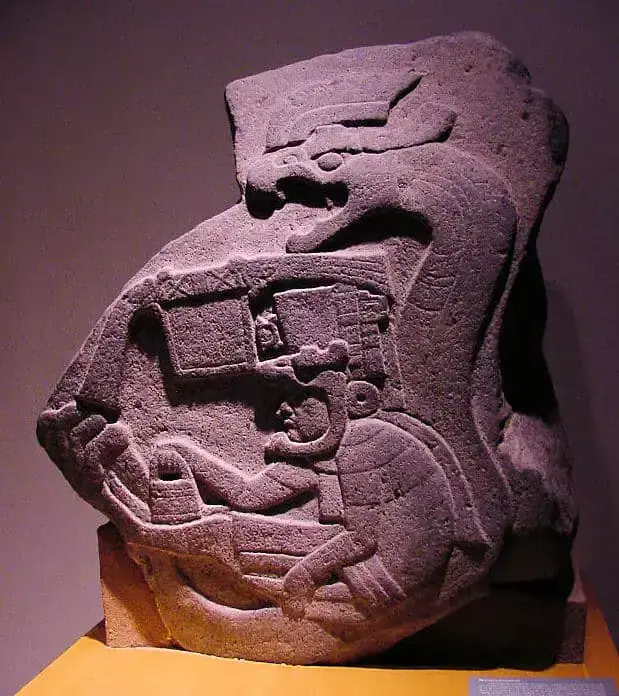
 A photo of La Venta Stela 19, the earliest known representation of the Feathered Serpent in Mesoamerica. Image Credit: Wikimedia Commons.
'La Venta' stele 19 offers the earliest known representation of the Feathered Serpent in Mesoamerica. The feathered serpent was known across ancient cultures in Mexico as either Kukulkan or Quetzalcoatl. This God is said to have arrived from the heavens, and brought great knowledge to ancient cultures.
La Venta is an ancient archaeological site that belonged to the ancient Olmec Civilization. Curiously, the Olmecs were one of the first civilizations to develop in the Americas.
 Another depiction of a deity inside of what appears to be a machine? Image credit: Museo Nacional de Antropología - INAH
'La Venta' stele 19 offers a curious representation of the feathered serpent: A humanoid figure sitting in some kind of 'vehicle' or 'chair,' as if manipulating some sort of device.
At first, this may not sound extraordinary or weird.
However, it becomes strange when you find nearly identical representations of gods, halfway around the world.
The Maori legend, and the god Pourangahua
 Image Credit: Biblioteca Pleyades
According to the Maori legend, the god Pourangahua flew on his magic 'bird' from his legendary dwelling Hawaiki to New Zealand.
Curiously, according to legend, this ancient god came from heaven, riding a 'silver bird.'
In fact, if we take a look at one of the oldest Maori prayers we will find its attribution to the God Pourangahua.
“I come, and an unknown earth lies below my feet. I come, and a new heaven turns above me. I come on to this earth, and it is a peaceful resting-place for me. O spirit of the planets! The stranger humbly offers you his heart as nourishment.”
If we compare the depiction of the feathered serpent in ancient Mesoamerica folklore to the God Pourangahua, we find a mysterious connection: both are represented nearly identically.
How is this possible? A mere coincidence?
But there is more...
Let's travel from ancient Maori legends to ancient Egypt.
 Another ancient God depicted in a sort of flying 'snake. Image Credit: Pinterest.
There, we will find a mysterious representation of the ancient Egyptian God Hapi.
Referred to as the "father of the gods," Hapi was the god of the annual flooding of the Nile in ancient Egyptian religion. This ancient Egyptian God symbolized fertility. This ancient Egyptian god also was usually given blue or green skin, which according to scholars represents the water.
Take a look at how he is sometimes depicted. Once again, we have a strange similarity to the feathered serpent in Mesoamerica, and the god Pourangahua, in ancient Maori folklore.
Back to Mesoamerica
 Ancient alien theorists propose that it clearly depicts King Pakal in some sort of spaceship during takeoff, and they argue that his hands appear to be manipulating some sort of machinery.
We venture back to modern-day Mexico where we find another curious representation which has aroused the interest of ancient astronaut theorists: King Pakal.
The sarcophagus of king K’inich Janaab’ Pakal or more commonly known as King Pakal is one of the most talked about subjects when it comes to the ancient alien theory. The sarcophagus lid of this great Maya rulers has some pretty curious depictions.
Ancient alien theorists propose that it depicts King Pakal in some kind of spaceship during takeoff, and they argue that his hands appear to be manipulating some sort of machinery, his foot is located on a pedal while he is breathing through some sort of breathing apparatus. The theory about Pakal’s spaceship was first proposed by Erich von Däniken in his book Chariots of the Gods.
Once again, we see a depiction of a figure inside of some sort of machine.
 Ancient Astronauts
India: Footprints embedded in rock, evidence of ancient astronauts?
Are the footprints embedded in rock in India evidence of ancient astronauts? A village in central India has fueled discussions on numerous social networks about the discovery of a mysterious set of "f
 Ancient Astronauts
Aliens Visited Earth in the Ancient Past, but Where's the Evidence?
Extraterrestrial civilization visited the Earth in the distant past and there is evidence all around us. It isn't a question anymore, whether or no ancient man was visited by intelligent extraterrestr
 Ancient Astronauts
The Hopi Star Children Here to Restore a World Out of Balance
YouTube Video Here: https://www.youtube.com/embed/rbRV2WdVNyI?feature=oembed&enablejsapi=1 Many Native American tribes like the Hopi, Zuni, and Navajo believe extraterrestrial beings visited Earth