YouTube Video Here: https://www.youtube.com/embed/hJnEQCMA5Sg?feature=oembed&enablejsapi=1 In 2007, paleoanthropologist and rock art researcher Genevieve von Petzinger decided to set out to study
YouTube Video Here: https://www.youtube.com/embed/hJnEQCMA5Sg?feature=oembed&enablejsapi=1
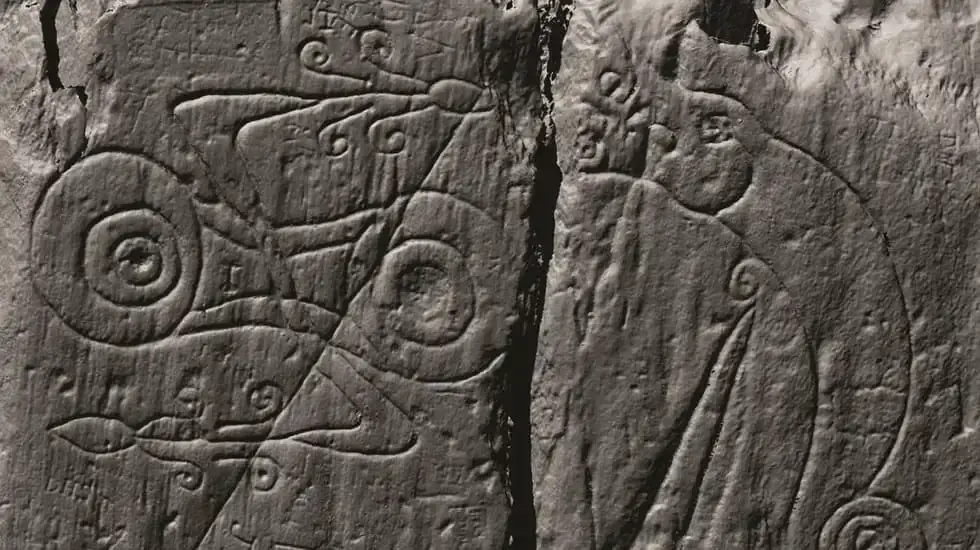
In 2007, paleoanthropologist and rock art researcher Genevieve von Petzinger decided to set out to study geometric signs found in caves and other sites, dating back as far as 40,000 years ago during the Stone Age. While most people are familiar with the familiar petroglyphs of animals, little was known about the symbols alongside them, even though there are far more of them. After traveling across the globe, Von Petzinger was able to document a group of symbols that appear in sites all over the planet. Her findings suggest a common early communication system dating back much further than the first written languages of Ancient Sumer 3,000 years ago.
"The funny thing is that at most sites the geometric signs far outnumber the animal and human images," said Genevieve von Petzinger. "But when I started on this back in 2007, there wasn't even a definitive list of how many different shapes there was; nor was there a strong sense of whether the same ones appeared across space or time."
The paleoanthropologist set out to compile a database of all the known geometric signs at rock art sites in Ice Age Europe. She found that there was vague information on some of the locations and that some hadn't been studied in half a century or more. She and her husband, Dillon, decided to target the lesser-studied sites across France, Spain, Portugal, and Sciliy. They found a treasure trove of new geometric signs.
"We found new undocumented geometric signs at 75 percent of the sites we visited," she explained.
The couple ventured deep into cave systems and found symbols on walls a mile into the earth in some cases. Later, she traveled to other sites, including in North America. Armed with a growing database of symbols, the researchers started to see some stunning similarities.
"Barring a handful out outliers, there are only 32 geometric signs. Only 32 signs across a 30,000-year time span and the entire continent of Europe. That is a very small number," she explained. "Now if these were random doodles or decorations, we would expect to see a lot more variation, but instead what we find are the same signs repeating across both space and time."
 A proto-writing system that may have developed in Africa and then spread throughout the world via Twitter
The researchers found that 65 percent of the signs stayed in use over the course of thousands of years. Some signs appeared to be locally used without wide distribution, while some were used across the world, all the way to Indonesia and Australia. They seem to have agreed-upon culturally-recognized meanings.
"It's starting to seem increasingly likely that this invention actually traces back to a common point of origin in Africa," said Von Petzinger.
The geometric shapes aren't like a written representation of a spoken language but are stylized abstract representations of things people saw in the world around them.
"If we're talking about geometric shapes, with specific culturally-recognized, agreed-upon meanings, then we could very well be looking at one of the oldest systems of graphic communication in the world," said Von Petzinger.
 Symbols discovered by Genevieve von Petzinger
These early representations may be the first inspirations for what later developed into abstracted written language. She thinks of them as similar to emojis today.? ?☺️ ? ?
"If you think about it, these [geometric signs] are like the great, great, great grandparents of emojis; simple little characters with huge amounts of information embedded into them," she said. "But you need to be part of the culture group to be able to decipher it. You have to know the code."
Now that the researchers have found the common symbols, they are working translate what they mean. Objects like a 16,000-year-old necklace from a burial site in France may serve as a helpful decoder. In this case, the necklace is covered with 45 different signs. (see below)
 Genevieve von Petzinger with ancient necklace via YouTube
You can find out more in the book "The First Signs: Unlocking the Mysteries of the World's Oldest Symbols," by Genevieve von Petzinger.
It's fascinating to know that ancient geometric symbols appear around the world dating back 40,000 years, though some experts point out that ancient humans created symbolic markings as far back as 500,000 years ago.
https://twitter.com/NatureNews/status/540447993707921408
See Genevieve von Petzinger discuss this topic in her TED Talk and National Geographic below:
YouTube Video Here: https://www.youtube.com/watch?v=aSF4zk2nsTU
Featured image: Screenshot via YouTube
 Human Origins
Human Origins Story Remains Incomplete with Missing Ancestors
YouTube Video Here: https://www.youtube.com/embed/9VFxefR23EY?feature=oembed&enablejsapi=1
 Human Origins
Venomous Humans Could Evolve Due to Common Ancestor with Reptiles
YouTube Video Here: https://www.youtube.com/embed/nqoqxA8p_AM?feature=oembed&enablejsapi=1 Scientists have learned that venomous humans could one day become real. The headline elicits the r
 Human Origins
Study suggests Neanderthals were wiped out by a common childhood ear infection
YouTube Video Here: https://www.youtube.com/embed/xX2iv4SyNHg?feature=oembed&enablejsapi=1 Of all the possible ways the Neanderthals may have gone extinct, it turns out that it may have been as si