

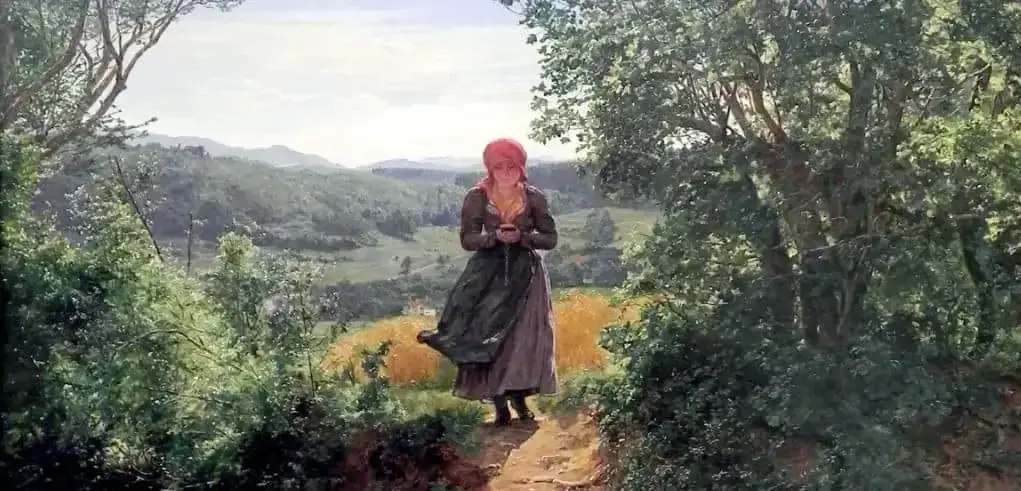
In fact, it's not a smartphone, its just evidence how we interpret art differently in today's modern society. When you look at the painting it immediately strikes you: A woman staring at a smartphone
In fact, it's not a smartphone, its just evidence how we interpret art differently in today's modern society.
When you look at the painting it immediately strikes you: A woman staring at a smartphone while walking, a scene not too unfamiliar with today’s way of life. However, despite the fact that many people would find that this scene shows what seems to be a smartphone, the truth is that this is ONLY evidence of how technology changes our interpretation of art.
And no, it is not time travel, and she's not holding a smartphone, I mean, after all, reception in 1860 would have been a pain in the ass, right?
How many of us have walked along the street, firmly grasping our precious piece of technology while sending texts or watching YouTube videos?
The scene depicted in this 19th-century Waldmuller painting seems to show the exact same thing, but… smartphones didn’t exist in 1980, did they?
The truth is no, they did not, but as noted by retired Glasgow local government officer Peter Russell who spotted the scene at the Neue Pinakothek museum in Munich:
Just like her on the dating app in Walmüller's Die Erwartete (c. 1850): pic.twitter.com/Lakl0vCkri
— Peter A. Russell2291 (@Planet_Pedro) October 23, 2017
"What strikes me most is how much a change in technology has changed the interpretation of the painting, and in a way, has leveraged its entire context. The big change is that in 1850 or 1860, every single viewer would have identified the item that the girl is absorbed in as a hymnal or prayer book. Today, no one could fail to see the resemblance to the scene of a teenage girl absorbed in social media on their smartphone."
 A painting called 'Die Erwartete' or the Expected, by Ferdinand Georg Waldmüller. Image Credit: Wikimedia Commons
The painting is believed to have been created sometime between 1850—1890 by Austrian artist Ferdinand Georg Waldmüller.
It’s called ‘The Expected One’ and shows a woman walking down a rocky path towards a kneeling man, with a flower in his hand, ‘expecting’ the young woman.
The young lady is illustrated firmly grasping a small rectangular object—strikingly similar to a modern-day smartphone.
 A close-up of the painting.
However, despite the fact that some may find a similarity between the object held by the young woman and a modern-day smartphone, the truth is that it isn’t a technological gadget but rather a hymnbook.
The painting is evidence that today’s society, which is engulfed by technological gadgets sees art in a different way than people 20, 30 or 50 years ago.
Had you shown this scene to someone 50 years ago, you would have never obtained an answer saying: “oh look that must be some sort of futuristic artifact…”, but rather; “…she’s holding a hymnbook or a bible...”
Technology changes people, and apparently, it also changes our interpretation of art.
This isn’t the first time we’ve gotten confused when looking at ancient paintings. Not long ago, we wrote about a painting depicting a scene from the 17th century, where a Native American man is portrayed holding in his hand a device that according to many is eerily similar to a modern-day Smartphone.
Speaking about the alleged smartphone in the painting in an interview with Motherboard, Dr. Margaret Bruchac from the University of Pennsylvania told said: “It does bear a rather uncanny resemblance, both in the way, it’s being held and the way it focuses his attention, to a smartphone.”
However, Dr. Bruchac explained how instead of being an actual smartphone, the object is more likely to have been an iron blade, saying that the painting was a ‘romanticized artistic genre’ which made it hard to tell.
Source: Motherboard
 Tesla & Frontier Science
The Future of humanity according to a man who fell into a coma and traveled to the year 3906
In 1921, Paul Amadeus Dienach, a Swiss-Austrian teacher with health problems, fell into a comatose state that lasted for one year. During this time, his consciousness traveled into the future and ente
 Tesla & Frontier Science
The story of Paul Dienach, a man who fell into a coma and woke up in the year 3,906
The story is beyond fascinating, and hard to believe according to many. Paul Dienach spent a year in a comatose state, victim of a strange disease. Upon awakening, he assured that his conscience had t
 Tesla & Frontier Science
The Chronovisor: A device used by the Vatican to look into the future and past
According to numerous reports and stories that have been published through the years, among the many alleged secrets the Vatican has, there is a device called the Chronovisor. The device enables its u