
Image Source Vilcabamba is an ancient Inca city, and the last refuge of the majestic Inca Empire until they fell to Spanish

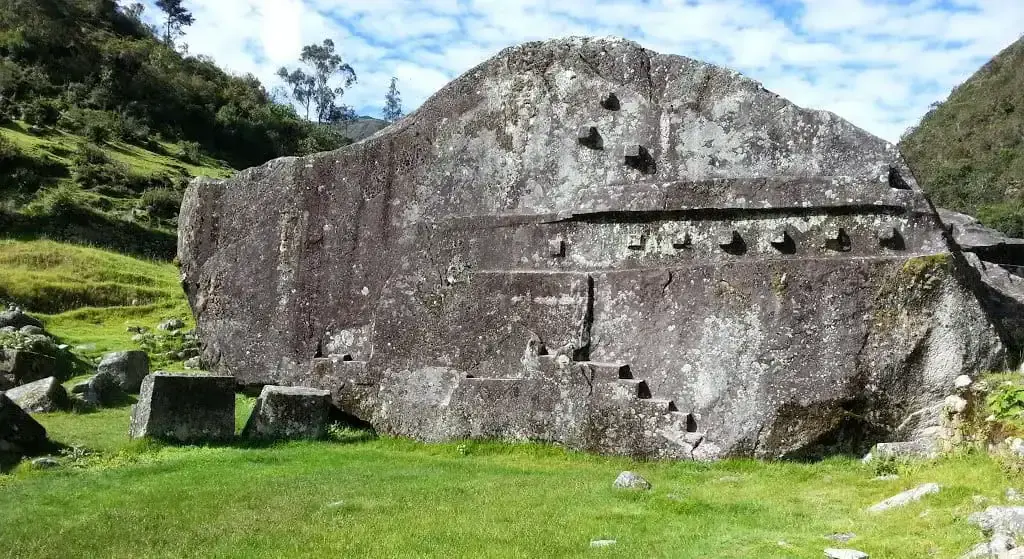
Vilcabamba is an ancient Inca city, and the last refuge of the majestic Inca Empire until they fell to Spanish Conquest in 1572. It is one of the many ancient Inca cities you probably had no idea of. The city was 'destroyed and lost', and it was dubbed as the Lost City of the Incas. There we find massive stone structures that defy logic and curious 'knobs' present on the megalithic stones that resemble those found at Ollantaytambo, Puma Punku, Sacsayhuaman, Coricancha, and Abydos among others.
Interestingly, Manco Inca –the founder of the city—retreated from Ollantaytambo to Vitcos, and finally to Vilcabamba.
The city was lost. Around 1892, the city was rediscovered and identified as Vilcabamba la Vieja or Old Vilcabamba by three Cuzqueños Manuel Ugarte, Manuel López Torres, and Juan Cancio Saavedra.
The site was brought to public attention when Hiram Bingham, in 1911 published a book called Lost City of the Incas detailing the site located some 130 kilometers west of Cuzco. However, as detailed by different authors, Bingham had no idea about its importance and firmly believed that Machu Picchu was the fabled Vilcabamba, the lost and last refuge of the Ancient Inca.
However, this ancient Inca city is not only important because of its history. To evaluate the importance of the site one has to take a close look at the incredible megalithic structures present there.
The cut surfaces on many of the structures present at Vilcabamba sho NO signs of tool marks and no evidence of bronze chisels possibly used during its construction.
This leads us to ask the most important and difficult question: How were these massive stone blocks made?
 https://hiddenincatours.com/
Mysterious knobs
On Vilcabamba's enigmatic stones we see mysterious 'knobs' which are present in countless other ancient sites around the globe.
These 'knobs' remain a profound mystery for scholars who are still unable to explain what they are.
Could these curious 'knobs' be evidence of a technology that predates the Inca?
Yes, of course, they could be, but in order to come to that conclusion, we need to dig deeper and explore further.
It cannot be a coincidence that similar structures with these 'knobs' are found in sites such as Puma Punku, Ollantaytambo, in the Americas.
 Vilcabamba Archaeological site Nusta Hispana. Image Credit: Wikimedia Commons.
They are also present in Turkey and Egypt.
This means that whatever these knobs were, ancient cultures all around the globe knew how to create them. Their exact purpose? We don't know. But they surely must have been important because they are present on some of the most important and enigmatic sites on the surface of the planet. Ollantaytambo, Puma Punku, Sacsayhuaman, Coricancha, Abydos, Temple Mount in Jerusalem, and even at the Pyramid of Menkaure. What do all of these sites have in common? They are MEGALITHIC sites were some of the largest and perfectly fitted stones are located. Coincidence?
More about lost cities of the Inca from Viper TV:
https://www.youtube.com/watch?v=03ThweJz6cs
 Mesoamerica & the Andes
Amazing Examples of Inca and pre-Inca Masonry (Photos)
Best Examples of Inca and pre-Inca masonry In this article, we bring you some of the best examples of Inca and pre-Inca masonry. I think that we can all agree that the Inca and pre-Inca cultures had i
 Mesoamerica & the Andes
10 incredible images of Sacsayhuaman that you probably haven't seen
It is perhaps one of the most incredible ancient sites in Peru, a megalithic site that is believed to predate the Inca themselves. The construction features found at Sacsayhuaman are breathtaking, pre
 Mesoamerica & the Andes
10 Breathtaking Images Of Machu Picchu
Machu Picchu is one of the most incredible sites on the planet. The breathtaking architecture and design surpasses the limits and imagination of engineering, it is an incredible accomplishment and off