
YouTube Video Here: https://www.youtube.com/embed/dm_7AEycc8k?feature=oembed&enablejsapi=1 A team of researchers from Yamagata University, along with IBM researchers, has found 143 new Nazca Lines
YouTube Video Here: https://www.youtube.com/embed/dm_7AEycc8k?feature=oembed&enablejsapi=1
A team of researchers from Yamagata University, along with IBM researchers, has found 143 new Nazca Lines in Peru with the help of A.I. technology. One small geoglyph of a 'humanoid' was found using A.I technology alone for the first time. Among these never-before-seen formations are some strange and fascinating images. Some larger ones can only be spotted from the sky.
Masato Sakai, a cultural anthropologist at Yamagata University, and his team worked with the IBM Thomas J. Watson Research Center in the U.S. They were able to train the A.I. to scan satellite imagery of the plateau for possible geoglyphs. Then the team traveled to the locations to confirm the discoveries.
The formations may date back 2,000 years and show what appear to be humanoid and animal representations. They range in size from five to 100 meters in length.
Ancient astronaut theorists will have a field day with some of the geoglyphs, which seem to show unknown objects, two-headed 'snakes' that could be interpreted as wormholes in space, and light-emitting beings in what could be astronaut suits and helmets. One humanoid has oversized eyes and a strangely-shaped head with connected wormhole-like paths.
A Feathered Serpent?
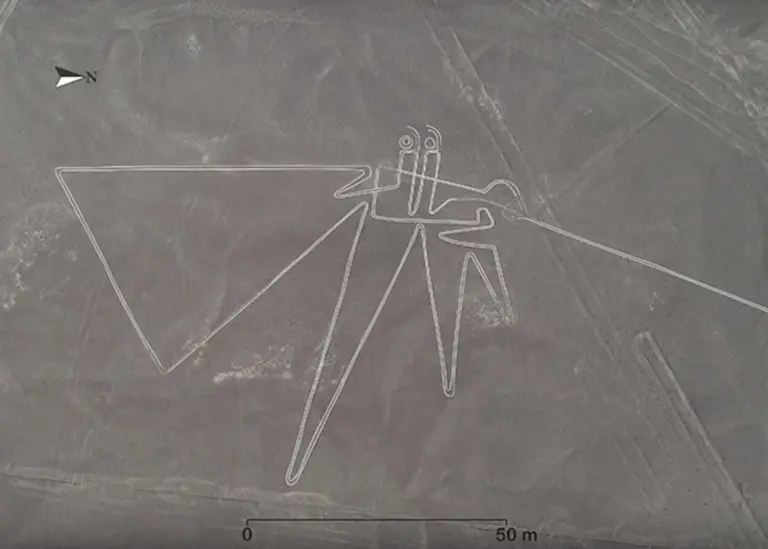
A geoglyph of a snake with a head on both ends instantly brings depictions of the Feathered Serpent or Quetzalcóatl to mind. The Feathered Serpent is one of the major deities of the ancient Mexican pantheon, so it's interesting to find such a similar depiction in Peru.
The first depictions of the Feathered Serpent go back to the Olmec stone carving La Venta Monument 19, dating back to between 1200 and 400 B.C. Around 900 A.D. The Toltec civilization worshipped Quetzalcoatl, and the practice is known to have spread as far south as the Yucatan peninsula.
 Monument 19, from La Venta, the earliest known representation of a feathered serpent in Mesoamerica. Courtesy George & Audrey Delange via Wikimedia Commons
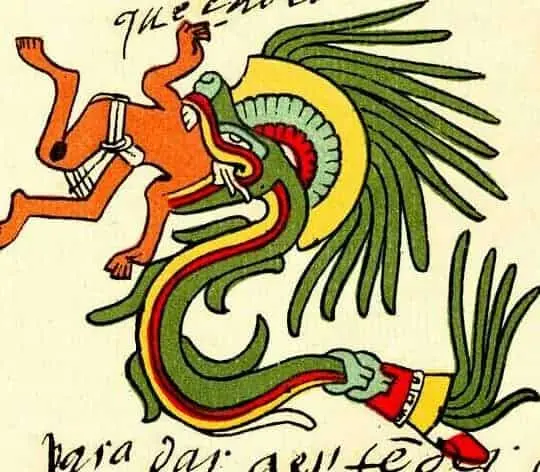
Now we can see that both in Peru and in Mesoamerica, a serpent is seen apparently eating people. However, in other cases, people are seen emerging from the 'serpent' as well, something seen in ancient cultures across the globe.
 Quetzalcoatl in feathered-serpent form as depicted in the Codex Telleriano-Remensis via Wikimedia Commons
 New Nazca Line featuring a 'snake' with two heads via YouTube
 Vision Serpent depicted on lintel 15 from Yaxchilan, Photo by Michel Wal via Wikimedia Commons
A couple of geoglyphs appear similar to dinosaurs at first glance. Another has a bizarre figure connected to two animals by a tether. One humanoid with radiating lines stands next to an orb-shaped object. Inside the orb, we see what could be a face. (see below)
 New geoglyph of a humanoid with a mysterious object via YouTube
New Nazca Lines
It's always interesting to see what archaeologists determine that these geoglyphs represent. Take a look at some of the new Nazca Lines below, followed by a video from Ancient Architects.


See more from Ancient Architects
More recent discoveries
Recently, state of the art technology has helped researchers find new clues about the possible reasons for the Nazca Lines. At the ends of some trapezoidal runway-like structures, researchers found mounds of rocks covering altar-like stone slabs. Around the 'altars' are walls embedded with the remains of sea creatures: crayfish claws, crab skeletons, and fragments of mollusk shells.
One theory is that oyster shells were a symbolic offering to the gods to bring rain to the arid desert area, 4,000 feet above sea level.
There are also shards of smashed pottery found at many geoglyphs. The pottery was smashed on purpose as part of a ritual, another offering to the gods to bring rain perhaps.
See more about these finds from Discovery U.K.:
YouTube Video Here: https://www.youtube.com/watch?v=cWIYb5zd6p8
In 2018, Peruvian archaeologist in the Palpa province of Peru found 50 new geoglyphs and corrected mistaken identities of some bird formations. Thanks to the new technology, we will almost certainly see many more exciting finds in the future, with multiple sites yet to be studied.
Advances are happening so fast that objects as small as pre-historic footprints are now being uncovered using ground-penetrating radar (GPR) in New Mexico. Who knows what discoveries will come as we follow the footprints of our ancient ancestors?
See more from IBM Research:
YouTube Video Here: https://www.youtube.com/watch?time_continue=45&v=Ce3g6vnfSiw&feature=emb_logo
Featured image: Screenshots via YouTube
 Mesoamerica & the Andes
Archaeologists discover 24 new lines at Nazca
A team of Japanese archaeologists discovered 24 new geoglyphs in Peru's Nazca Desert, which could be among the oldest in this area according to researchers from the Yamagata University from Japan. Alm
 Mesoamerica & the Andes
20 Facts About The Nazca Lines
[caption id="attachment_8708" align="aligncenter" width="981"] Nazca lines, tree (seen from the observation tower). Image Credit: Wikimedia Commons[/caption] It was in 1927, when Airlines started flyi
 Mesoamerica & the Andes
A message to the gods? Massive Geoglyphs around the world that can only be seen from above
Geoglyphs are figures and/or symbols built on hillsides or plains, using different techniques like adding stones with dark tones of volcanic origin as a mosaic, to contrast on a lighter background cha