

YouTube Video Here: https://www.youtube.com/embed/Dfl4ZaiucpQ?feature=oembed&enablejsapi=1 For those who follow the stories of the ancient Sumerian tablets first discovered in the 1800s, you know
YouTube Video Here: https://www.youtube.com/embed/Dfl4ZaiucpQ?feature=oembed&enablejsapi=1
For those who follow the stories of the ancient Sumerian tablets first discovered in the 1800s, you know that gold is central to the story. The Anunnaki, extraterrestrials from another planet, mined for precious gold in southern Africa when they arrived on Earth. The element has unique qualities that make it invaluable for many reasons; from jewelry to electrical components, to insulation used in space travel. Today, scientists have made a big leap in unlocking the potential of 2D gold, thousands of years later.
Now, researchers from the University of Leeds in the U.K. have created the world's "thinnest gold" only two atoms in thickness. It's so thin; they consider it 2-dimensional. They say it's a "landmark achievement" in nanomaterials with potential in the medical and electronics industries.
"The previous reported thinnest unsupported 2D gold nanosheets have a minimum thickness of 3.6 nanometers," Sunjie Ye, lead author of the study, told Newsweek. "Our work represents the first fabrication of freestanding 2D gold with a sub-nanometer thickness, that is, we have brought 2D gold to sub-nanometer scale, which is a new focus of nanotechnology."
"Gold is a highly effective catalyst. Because the nanosheets are so thin, just about every gold atom plays a part in the catalysis. It means the process is highly efficient," Stephen Evans, a researcher from Leeds who supervised the study, said in a statement."Standard benchmark tests revealed that gold nanoscale sheets were ten times more efficient than the gold nanoparticles conventionally used in industry. Our data suggests that industry could get the same effect from using a smaller amount of gold, and this has economic advantages when you are talking about a precious metal," said Evans.
According to the article, the flexible 2D gold might be used to "develop artificial enzymes" for such technologies as water filtration and improved medical diagnostic tests.
The advanced use of gold in this manner is new to science in 2019. On the other hand, if you subscribe to the story of the Anunnaki from the cuneiform tablets of Mesopotamia, it could be a throwback to technology thousands of years old. According to Ancient Astronaut theory, the Anunnaki genetically engineered the first man, or "Adamu" as slaves for their gold-mining operations some 450,000 years ago. The gold was needed for the technology to save the home planet, which was falling into environmental ruin.
If we put aside skepticism for a moment and consider this to be true, could humans learn how to use gold for advanced technology to save our own environment in the future?
Related: Why Was Gold So Important To The Ancient Anunnaki?
Much of the wisdom of these ancient beings was passed along to modern humans, but why not the technology associated with gold? For example, some of the system of mathematics and measurements we still use originated in ancient Mesopotamia. Consider that the hours and minutes that define our daily lives, based on the number 60, came from the ancients.
Related: Did the Anunnaki reveal keys to the universe in the first system of mathematics?
Zecharia Sitchin (1920 - 2010), the famous (or infamous, depending on your view?) author who expounded on the story of Anunnaki for years, was quoted in the New York Times in 2010 as the paper explored his ideas. Many people consider it bunk, but to Sitchin and a growing audience, the tablets aren't just myth but record actual events.
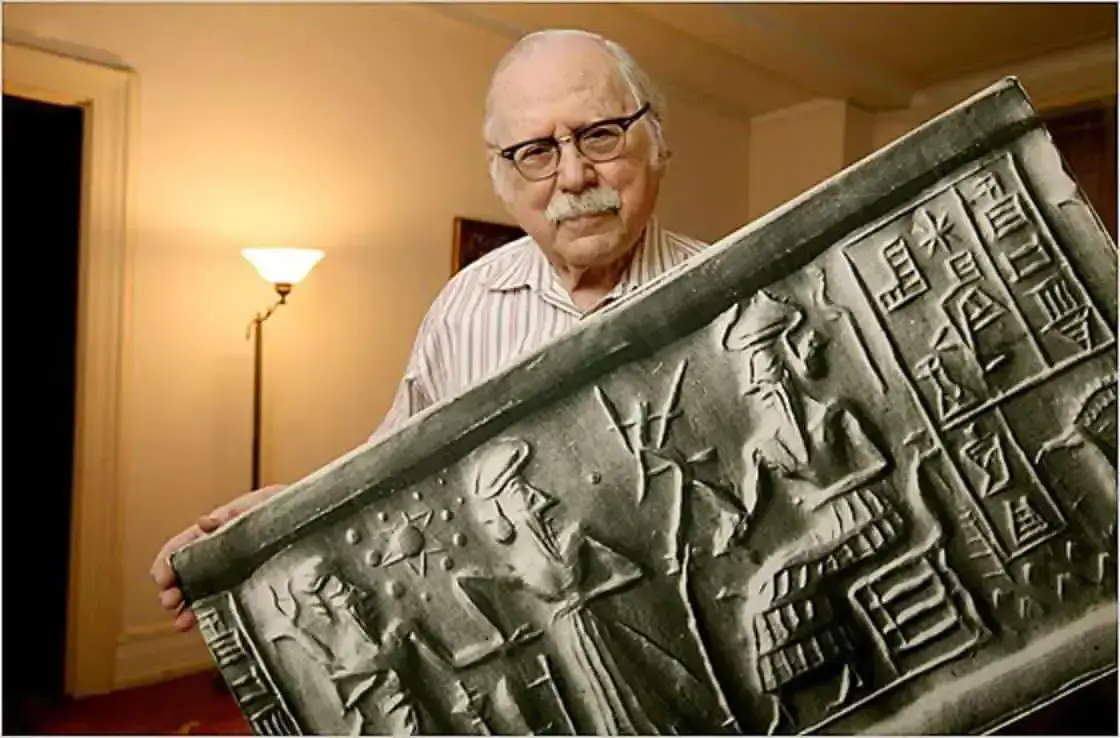
 Zecharia Sitchin via Anunnaki.org holds a tablet he says shows the Anunnaki passing along technology for agriculture to humans.
This is how Mr. Sitchin explains what scientists attribute to evolution. He says the aliens' cities were washed away in a great flood 30,000 years ago, after which they began passing on their knowledge to humans. He showed a photograph of a woodcarving from 7,000 B.C. of a large man handing over a plow to a smaller man: Ah, the passing on of agricultural knowledge. Anyway, he said, the Nibiru-ites finally jetted home in their spacecraft, around 550 B.C."This is in the texts; I'm not making it up," Mr. Sitchin said, finishing his coffee. "They wanted to create primitive workers from the homo erectus and give him the genes to allow him to think and use tools."
Today, humans are indeed thinking and using tools, but we still clearly have far to go before we could really be considered an advanced civilization. At least the use of 2D gold seems to be another small step in the right direction.
For a discussion of the Anunnaki and their quest for gold on Earth, as told in the Sumerian tablets, watch this video from Universe Inside You below
 Ancient Technology
Ancient Egyptian technology: a propeller that is thousands of years old?
Some believe that this is one of the best pieces of evidence suggesting that ancient Egyptians had knowledge and technology far beyond our own. According to ancient astronaut theorists, this object pr
 Ancient Technology
Ancient Power Sources of the Gods: Advanced technology and our ancestors
YouTube Video Here: https://www.youtube.com/embed/UfFRFPJbsHM?feature=oembed&enablejsapi=1 What sounds crazier, The Egyptian Pyramids producing wireless energy? Or transporting stone blocks that w
 Ancient Technology
The ancient Egyptians may have used infrasound to create altered states of consciousness in the pyramids
YouTube Video Here: https://www.youtube.com/embed/gL6jwZNtVVk?feature=oembed&enablejsapi=1 The Egyptian pyramids are miracles of construction and scientific achievement, which is even more amazing