It is said that the Book of Thoth contains a number of spells, one of which allows the reader to understand the speech of animals, and one of which allows the reader to perceive the gods themselves. L
It is said that the Book of Thoth contains a number of spells, one of which allows the reader to understand the speech of animals, and one of which allows the reader to perceive the gods themselves. Legend says that he who read the contents of the book would obtain the means to decipher the secrets and master the earth, the sea, the air and the celestial bodies.
One of the most mysterious books to have ever been mentioned in the history of mankind is the Book of Thoth—a sacred and mysterious book of the ancient Egyptians, written by an ancient God.
According to historical records, the Book of Thot was a collection of ancient Egyptian texts which were written y Thoth—the ancient Egyptian god of writing and Knowledge.
They include numerous texts that were claimed to exist by ancient authors and a magical book that appears in an Egyptian work of fiction.
The Book of Thoth appears fragmented in diverse papyri, the majority pertaining to the second century of the Ptolemaic period.
The Book of Thoth is cited for the first time in the so-called Turis papyrus, published in Paris at the end of the eighteenth century, which describes a failed attempt to kill a pharaoh, using a series of spells taken from the Book of Thoth.
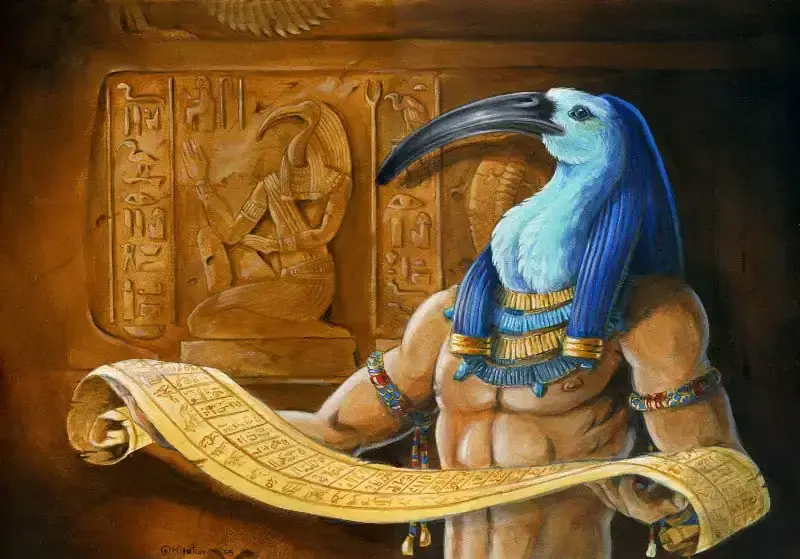
 He Who Balances by Hbruton
*Note: Philip Coppens writes how the "Turis Papyrus, it does not exist but was probably derived from the well-known Turin Papyrus. The Turin Papyrus of Kings, also known as the Turin Canon, is a hieratic manuscript of the 19th dynasty of Egypt, listing the kings of Egypt from the earliest times to the reign of Ramses II (1279–13 BC), under whom it was written. Thus, not only does the Turis resemble the Turin in name, but also in date of origin."
In addition, there are different versions, although the compilations have led to reconstruct a history common to all of them, basically a dialogue in which there are two interlocutors, the god Thot and a disciple who "aspires to know", although there is another god, probably Osiris, who also speaks with the disciple.
The literary framework could be compared with the Greek hermetic texts, which also show dialogues between Hermes-Thot and his disciples; however, the presence of some texts prior to the first-century place it ahead of the first Greek hermetic philosophical texts.
The name of 'Book of Thot' has been applied to numerous texts.
Manetho—an ancient Egyptian priest—claimed that Thot had written 36.525 books, although some investigators like Seleukos affirm that they were around 20,000.
The fictional Book of Thoth appears in an ancient Egyptian story from the Ptolemaic period which speaks of a brave ancient Egyptian prince called Neferkaptah who decides to recover the Book of Thoth, hidden at the depths of the Nile.
The book, written by Thoth, is said to contain two spells, one of which allows the reader to understand the speech of animals, and one of which allows the reader to perceive the gods themselves.
"The Book is at Koptos in the middle of the river.
In the middle of the river is an iron box,
In the iron box is a bronze box,
In the bronze box is a keté-wood box,
In the keté-wood box is an ivory-and-ebony box,
In the ivory-and-ebony box is a silver box,
In the silver box is a gold box,
And in the gold box is the Book of Thoth.
Round about the great iron box are snakes and scorpions and all manner of crawling things, and above all, there is a snake which no man can kill. These are set to guard the Book of Thoth." (Source)
The fictional Book of Thoth
Legend suggests that the book was originally hidden at the bottom of the Nile near Coptos, where it was locked inside a series of boxes guarded by serpents no man could kill.
The brave ancient Egyptian prince Neferkaptah decided to recover it. He fought the serpents and succeeded retrieving it, but in punishment for his theft from Thoth, the gods killed his wife Ahwere and son Merib.
Neferkaptah eventually committed suicide and was said to have been entombed along with the book.
Generations later, the story's protagonist, Setne Khamwas (a character based on the historical prince Khaemwaset), manages to steal the book from Neferkaptah's tomb despite fierce opposition from Neferkaptah's ghost.
Setne eventually meets a beautiful woman who seduces him into killing his children and humiliating himself in front of the pharaoh.
He discovers that what he had seen was, in fact, an illusion put forth by Neferkaptah, and in fear of further retribution, Setne decides to return the book to Neferkaptah's tomb.
At Neferkaptah's request, Setne finds the bodies of Neferkaptah's wife and son and buries them in Neferkaptah's tomb, which is then sealed for eternity.
The story is meant to reflect the ancient Egyptian belief that the gods' knowledge is not meant for ordinary humans to possess.
Fragments have been found in Berlin, Paris, Vienna, Florence, Copenhagen and New Haven.
It was believed that he who read the contents of the book would obtain the means to decipher and master secrets related to the earth, the sea, the air and the celestial bodies.
It also conferred the faculty of assimilating the language of animals, giving life back to the dead and acting on distant and nearby minds.
The church father Clement of Alexandria, in the sixth book of his work Stromata, mentions forty-two books used by ancient Egyptian priests that he says contain "the whole philosophy of the Egyptians".
All these books, according to Clement, were written by Hermes (an ancient pre-existing Greek god that the Greeks likened to Thoth, claiming they were one and the same god, due to the fact they had similar qualities, i.e. both invented writing).
Sources used:
FRAGMENTS OF THE BOOK OF THOTH
 Mythology & Ancient Knowledge
Secret Ciphers: The Forgotten Language Of The Ancients
Around the world there exist a number of undeciphered texts that date back as far as the Neolithic (8000 BCE). These ancient writing systems must be viewed with an open mind as they may have been comp
 Mythology & Ancient Knowledge
The Ancient Emerald Tablet Of Hermes Trismegistus; The Ultimate Source Of Alchemy?
The Emerald Tablet, aka Smaragdine Table, or Tabula Smaragdina is an ancient text that is said to contain the secret of the prima materia and its transmutation. Highly regarded by alchemists around th
 Mythology & Ancient Knowledge
5 'controversial' ancient Books that could shatter the foundations of history
Throughout the years, archaeologists have come across incredible discoveries. Some of these discoveries are ancient manuscripts which have been found to portray history from a different point of view.