

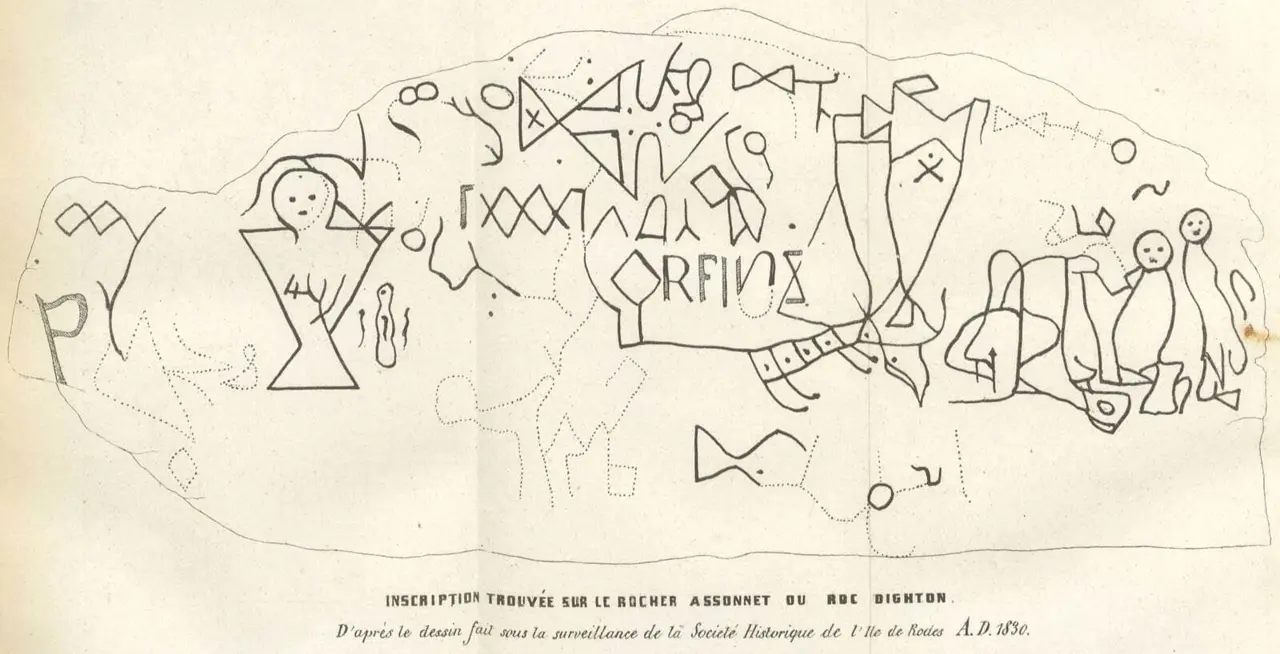
The Dighton rock is without a doubt one of the most mysterious findings of the Americas. The rock with mysterious cuneiform-style inscriptions has been the subject of intense debate among researchers
The Dighton rock is without a doubt one of the most mysterious findings of the Americas. The rock with mysterious cuneiform-style inscriptions has been the subject of intense debate among researchers and scholars for centuries, yet no one has been able to properly explain its origin nor decipher it. The 40-ton boulder approximately 1.5 meters in height, 2.9 in width and 3.4 meters length was found partially submerged in the Taunton River in Massachusetts.
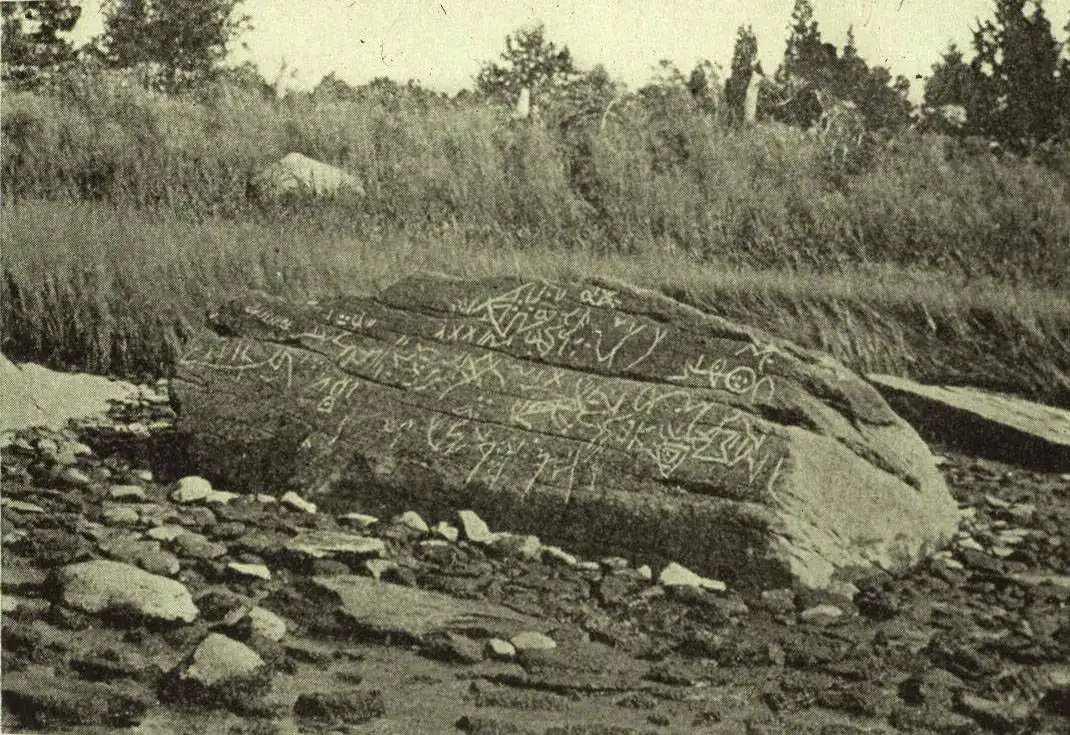 Photograph of the Dighton Rock taken by Davis in 1893
The mysterious boulder, covered in petroglyphs and intricate ancient designs has been installed in a memorial building near the town of Berkley.
The very first mentions about it can be found in Rev. Cotton Mather’s book “The Wonderful Works of God Commemorated,” published in 1690:
“Among the other Curiosities of New-England, one is that of a mighty Rock, on a perpendicular side whereof by a River, which at High Tide covers part of it, there are very deeply Engraved, no man alive knows How or When about half a score Lines, near Ten Foot Long, and a foot and half broad, filled with strange Characters: which would suggest as odd Thoughts about them that were here before us, as there are odd Shapes in that Elaborate Monument..”
Today there are dozens of theories that try to explain the origin of the enigmatic boulder. According to Ezra Stiles, an American researchers and author the rock was carved by ancient Phoenician explorers while other people claim that the rock carvings were made by Portuguese or even Viking explorers. The truth hoverer, remains a profound mystery.
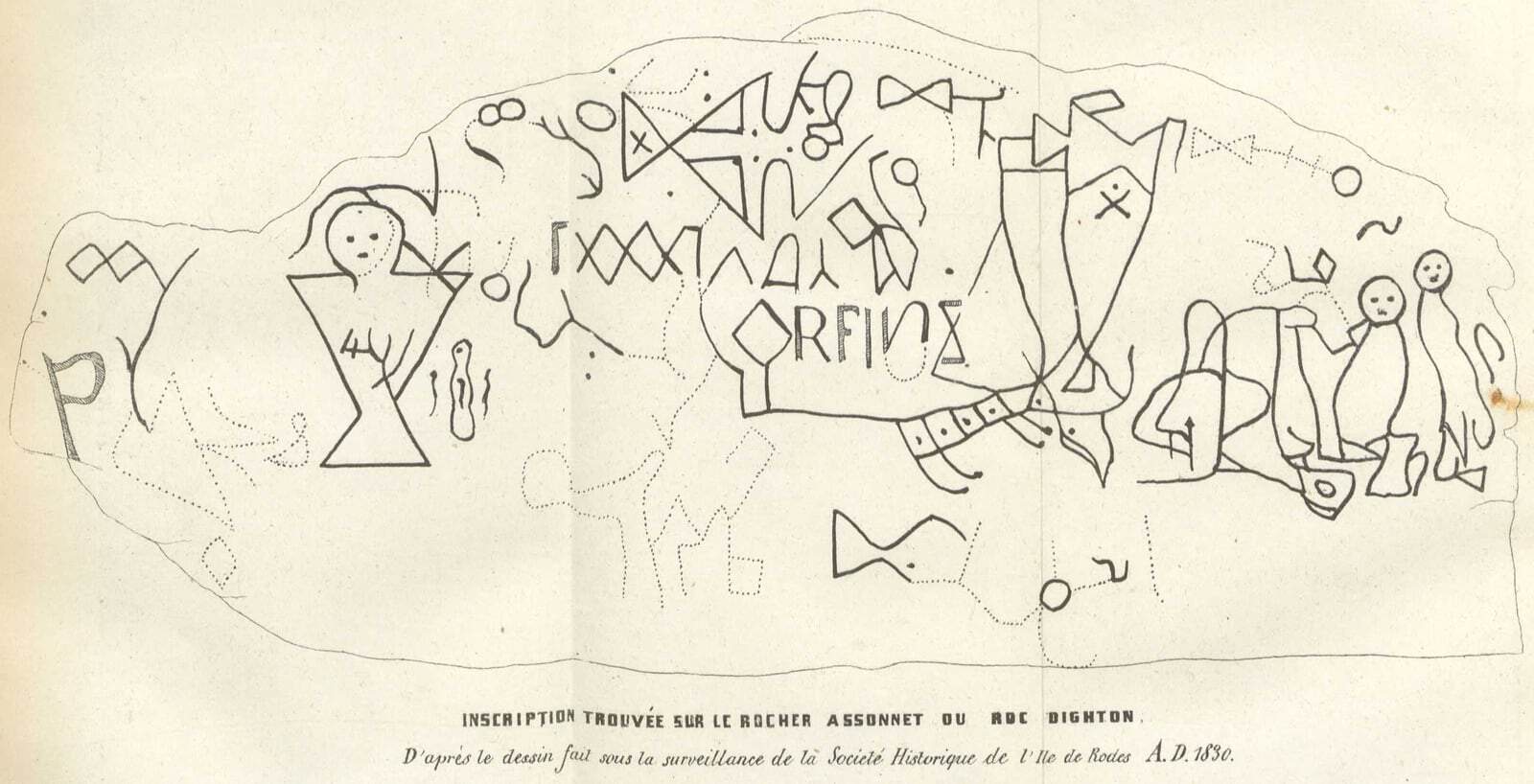 A exact copy of all symbols or petroclyphes by the Historical Commission of Providence, Rhode Island, published 1830
Image credit Wikimedia Commons
Among other theories, Count Antoine Court de Gobelin, a French nobleman suggested in 1784 that the Dighton Rock was in fact product of ancient explorers from Carthage who visited the region thousands of years ago.
These are not the only mentions about the mysterious boulder. According to Gavin Menzies, in his book 1421: The Year China Discovered The World, he states tats the intricate designs were made by ancient Chinese sailors who visited the American Continent nearly one hundred years before Columbus.
While neither of the above theories have been properly explained the origins of the mysterious 40-ton boulder, there are those who draw similarities between the Dighton Rock and the 6,000 year old Inga Stone in Brazil. The carvings of the Inga Stone remain a mystery but some symbols have been identified and accepted throughout the archaeological community. Some researchers argue that the Inga Stone has a Phoenician origin, but this theory has not been confirmed. Brazilian researcher Gabriele Baraldi has spent great time in studying the encrypted messages at the Inga stone, according to his theory, the Inga Stone carvings are proof of unknown ancient technology.
 Ancient Technology
Ancient people knew that the Earth was round 2000 years before Columbus
We have been told in school that it was Christopher Columbus the person who found out that the Earth is round and set out on a journey to prove it. It is just one of the many "little" lies that have b
 Ancient Technology
Researchers find evidence: Ancient China discovered America thousands of years before Columbus
It appears that after all, we have history all wrong. Mainstream history and archaeology can try to deny these facts as much as they want, but eventually, things will change and people will open their
 Ancient Technology
The Egyptian Ankh Cross Found In Mexico
[caption id="attachment_8394" align="aligncenter" width="1226"] The Egyptian Ankh cross found in Mexico. Image Credit: commons.wikimedia.[/caption] Calixtlahuaca, present day Toluca has one of the mos