

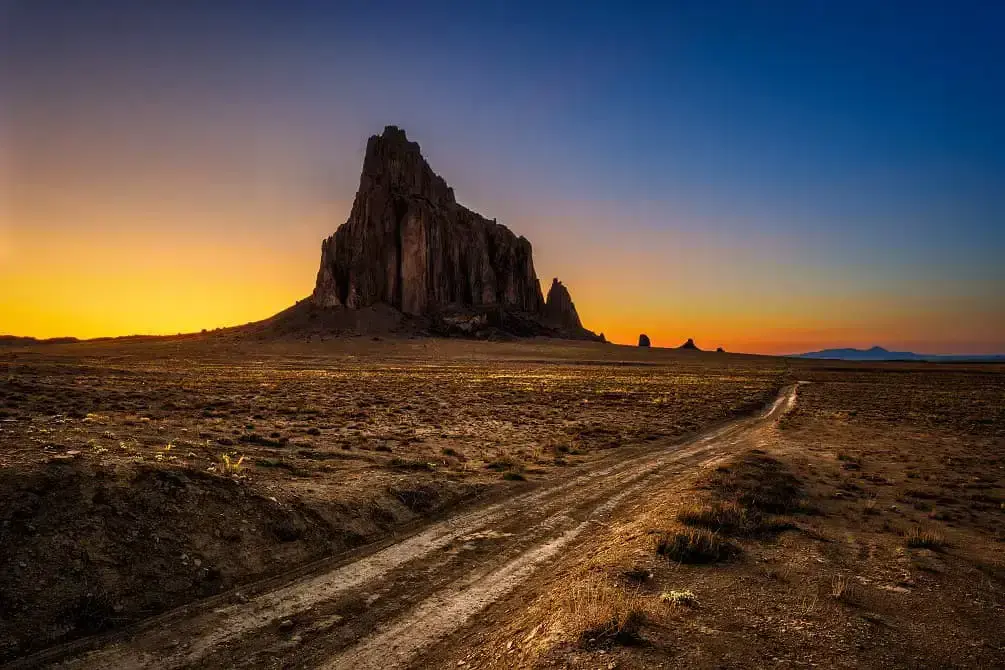
Called Tsé Bitʼaʼí or “the rock with wings,” Navajo Legends tell how Shiprock was a piece of land that became a bird, carrying the ancestral people of the Navajo on its back. After being transported f
Called Tsé Bitʼaʼí or “the rock with wings,” Navajo Legends tell how Shiprock was a piece of land that became a bird, carrying the ancestral people of the Navajo on its back. After being transported from another place, the Navajos lived on the monolith, "coming down only to plant their fields and get water."
Located southwest of the city of Shiprock, New Mexico, the strange Shiprock 'peak' is protected territory of the Navajo Nation.
Located in the center of an area inhabited by the ancient Pueblo people, a prehistoric Native America Tribe often referred to as the Anasazi, Shiprock is referred to as rock with wings" or "winged rock" thanks to the legend of the great bird that brought the Navajo from the north to their present lands.
 A view of Shiprock. Image Credit: Shutterstock.
It rises about 500 meters above the desert of New Mexico and has been the protagonist of a number of films and novels of the West.
Rising high above the surrounding dry landscape, Shiprock has long been a fascination not only to photographers and explorers but to anyone who travels to visit it.
Currently, it is the focus of attention of many photographers due to its beauty, but also thanks to the sheer sizes of stories and legends that sit on its back.
 A Satellite image of Shiprock. Image Credit
This mysterious monadnock was formed some 27 million years ago, around 1,000 meters below the surface of the Earth. Shiprock is composed of fractured volcanic breccia and black dikes of igneous rock called Minette, and it is the erosional remnant of the throat of a volcano, and the volcanic breccia formed in a diatreme.
Over the years, the volcano eroded away, leaving behind a memory in the landscape, a strange geological formation with a height of around 460 meters, adorning the surrounding area with its mesmerizing beauty.
The name of Shiprock was given by colonists, because of the resemblance that this peak had to the enormous 19th-century clipper ship. Americans first called the summit "The Needle," a name given to the topmost pinnacle by Captain J. F. McComb in 1860.
 The Navajo name for the peak, Tsé Bitʼaʼí, "rock with wings" or "winged rock", refers to the legend of the great bird that brought the Navajo from the north to their present lands. Image Credit: Shutterstock
Its Navajo name is Tsé Bit 'A'í, which means "rock with wings."
According to the Navajo legend, it represents the giant bird that carried the ancestral people of the Navajo on its back. Legends have it that at sundown, the massive ‘winged creature’ settled where Shiprock is today, promptly turning to stone.
Stories tell how the ancient Navajo settled on the rock's peak, "coming down only to plant their fields and get water."
One day, however, Shiprock was struck by a massive lightning storm causing great suffering and destruction, stranding the women and children on top to starve.
Since that time, the rock has been forbidden to people as the Navajo elders say, visitors may disturb the ghostly spirits of those left behind. According to Navajo tradition, the Shiprock formation is in the Four Corners region and plays a significant role in Navajo religion, myth, and culture.
Per Navajo customs, human ascents have been expressly off-limits since 1970.
 Mythology & Ancient Knowledge
The unanswered mysteries of the Anasazi
The great American southwest is considered by many as a place of extremes, ancient people, spirits and legends that even today, inhabit the region. Thousands of years ago, an ancient culture flourishe
 Mythology & Ancient Knowledge
Sky Woman: The Overlooked Iroquois Influence on America
Today, the Iroquois (Haudenosaunee) culture teaches kids from birth about the Sky Woman, Mother Earth, and Grandmother Moon. The tribes instill a deep abiding respect for women who continue to uphold
 Mythology & Ancient Knowledge
Legends of the Menehune, mythological dwarf people of Hawaii who may still exist today
YouTube Video Here: https://www.youtube.com/embed/-Kv9J7Ay2nA?feature=oembed&enablejsapi=1 All across the world, there are stories about people of giant stature, and also of relatively small peopl