
It is believed that the Moon-Eyed people saw very poorly throughout the day, had pale skin, and looked different from Native Americans. It is believed that these mysterious people erected some of the
It is believed that the Moon-Eyed people saw very poorly throughout the day, had pale skin, and looked different from Native Americans. It is believed that these mysterious people erected some of the oldest structures in Northern America.
The Cherokee people were one of the ancient Native American cultures that formed the Five Civilized Tribes along with the Choctaw, Chickasaw, Creek, and Seminoles.
This ancient culture inhabited the present territory of the states of Alabama, Georgia, Kentucky, North Carolina, South Carolina, Tennessee and Virginia in the southeastern United States when the Europeans came into contact with them in the sixteenth century.
The actual origin of the Cherokee people remains a debated topic among scholars.
There are two prevailing theories.
One is that the Cherokee, an Iroquois-speaking people, are relative latecomers to Southern Appalachia, who might have migrated in late prehistoric times from the northern areas, the traditional territory of the later Haudenosaunee confederation five nations and other Iroquois speaking peoples.
Researchers in the 19th century recorded conversations with elders who related an oral tradition of the migration of the Cherokee people south of the Great Lakes region in antiquity.
The second theory, which is discussed by scholars suggests that the Cherokee had been in the southeast for thousands of years.
However, there is little to no archaeological evidence for this theory.
The Connestee people, believed to be ancestors of the Cherokee, occupied western North Carolina circa 200 to 600 CE.
The Cherokee people were one of those who formed the Five Civilized Tribes. They were called that because of the Europeans, who, upon their arrival thought that these five cultures had a degree of civilization superior to that of the rest of the Native Americans. According to scholars, this allowed them to quickly adapt to white customs—which did not help them to avoid being stripped of their lands and displaced to Oklahoma from 1838, in what was known as the Trail of tears.
But the Cherokee were apparently viewed differently from the rest of the native American cultures because of mysterious legends, of a mysterious people that predated the great Cherokee nation.
The Legend of the Moon-Eyed people
The so-called Moon-eyed people were mysterious inhabitants of Northern America who are believed to have lived in Appalachia until the Cherokee expelled them.
A book written in 1797 by Benjamin Smith Barton—an American botanist, naturalist, and physician, New Views of the Origin of the Tribes and Nations of America, explains that they were called moon-eyed people because they saw very poorly throughout the day, and had a number of different features from the rest of the native Americans.
Barton wrote, citing as a source Colonel Leonard Marbury that "the Cheerake tell us, that when they first arrived in the country which they inhabit, they found it possessed by certain 'moon-eyed-people,' who could not see in the day-time. These wretches they expelled."
Later additions to the story about the Moon-eyed people suggests that they had white skin, that they created the area's pre-Columbian ruins, and that they went west after the Cherokee expelled them.
Another book written by ethnographer James Mooney in 1902 describes how there is a "dim but persistent tradition" of a mysterious, ancient people who preceded the Cherokee in lower Appalachia.
Ancient legends suggest that the white-skinned people of Appalachia built numerous ancient structures in the area, including perhaps, one of the largest cities ancient cities in Northern America; Cahokia. Curiously, scholars know very little about Cahokia today. The city's original name is unknown, as the ancient builders left no written records behind.
Some theories suggest that the so-called Moon-eyed people may have been the very same Lionel Wafer encountered among the Kuna people of Panama, who were also called "moon-eyed" because of their ability to see better at night than day.
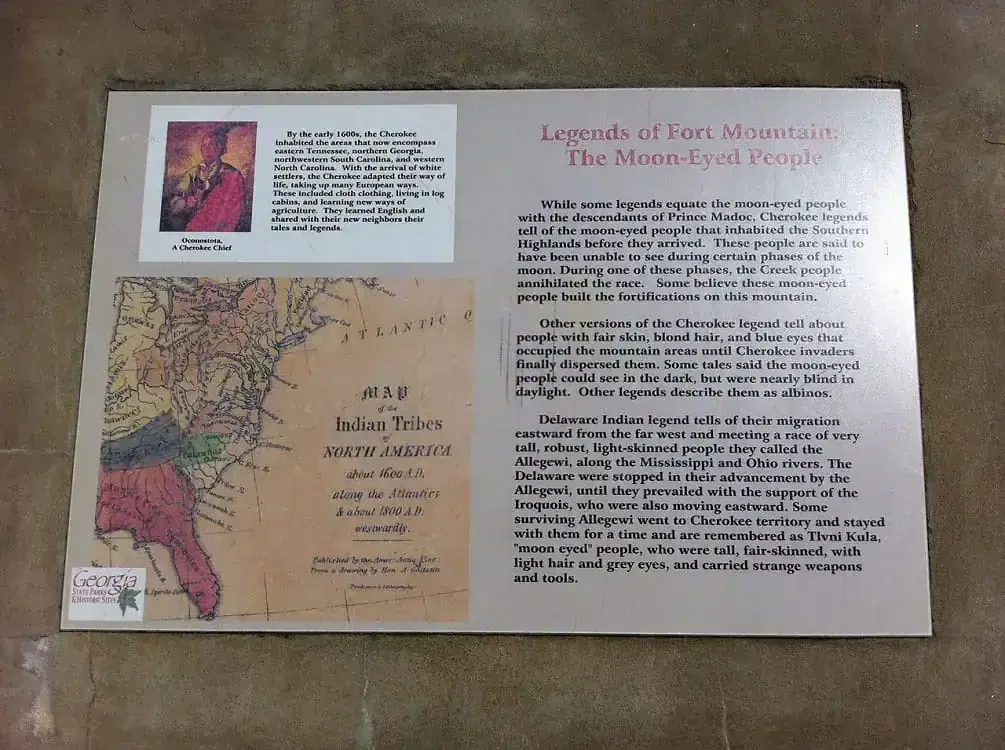
The Fort Mountain state park is believed to have been erected by the moon-eyed people.
[caption id="attachment_30951" align="aligncenter" width="1005"] Plaque at Fort Mountain State Park. Image Credit: Wikimedia Commons.[/caption]
Some authors note that this Cherokee tradition may have been influenced by contemporary European-American legends of the "Welsh Indians."
According to these legends, these ancient ruins were attributed to Welsh pre-Columbian voyages.
If we take a look at a 16th-century manuscript published by Welsh antiquarian Humphrey Llwyd, a Welsh Prince called Madoc is believed to have sailed from Wales across the Atlantic to what is now Mobile Bay, Alabama in the year 1171.
John Sevier an American soldier, frontiersman, and politician, and one of the founding fathers of the State of Tennessee wrote that on one occasion, the Cherokee leader Oconostota said in 1783 how local mounds had been built by white people, who the Cherokee eventually expelled from the lands.
According to Sevier’s accounts, the Cherokee leader confirmed that these mysterious people were in fact, Welsh from across the ocean.
If true, this theory would have huge implications.
Featured image credit: People Of One Fire.
 Mythology & Ancient Knowledge
The unanswered mysteries of the Anasazi
The great American southwest is considered by many as a place of extremes, ancient people, spirits and legends that even today, inhabit the region. Thousands of years ago, an ancient culture flourishe
 Mythology & Ancient Knowledge
Sky Woman: The Overlooked Iroquois Influence on America
Today, the Iroquois (Haudenosaunee) culture teaches kids from birth about the Sky Woman, Mother Earth, and Grandmother Moon. The tribes instill a deep abiding respect for women who continue to uphold
 Mythology & Ancient Knowledge
Legends of the Menehune, mythological dwarf people of Hawaii who may still exist today
YouTube Video Here: https://www.youtube.com/embed/-Kv9J7Ay2nA?feature=oembed&enablejsapi=1 All across the world, there are stories about people of giant stature, and also of relatively small peopl