Numerous maps have been discovered depicting our planet as it was before the last ice age. Many people claim that before written history, extremely advanced ancient civilizations existed on Earth and
Numerous maps have been discovered depicting our planet as it was before the last ice age. Many people claim that before written history, extremely advanced ancient civilizations existed on Earth and these ancient cultures, ignored by mainstream history, had well-developed cartography systems comparable in precision to the ones we have today.
No one has been able to explain just how these extremely ancient maps, depicting regions of our planet like Antarctica without ice, dating back thousands of years exist. Many argue that these maps are the product of Antediluvian civilizations that inhabited our planet thousands of years before written mainstream history.
The Antediluvian period or the Pre-Flood period is referred to the time ‘before the great deluge’. In the Bible, this time is set between the fall of man and the Noachian deluge, the story of the Flood as described in Genesis.
While most of us are familiar with the Piri Reis map –which has been validated by scholars who remain baffled and cannot explain their precision and level of detail—most of us are unaware that there are numerous other maps that depict the same scenery.
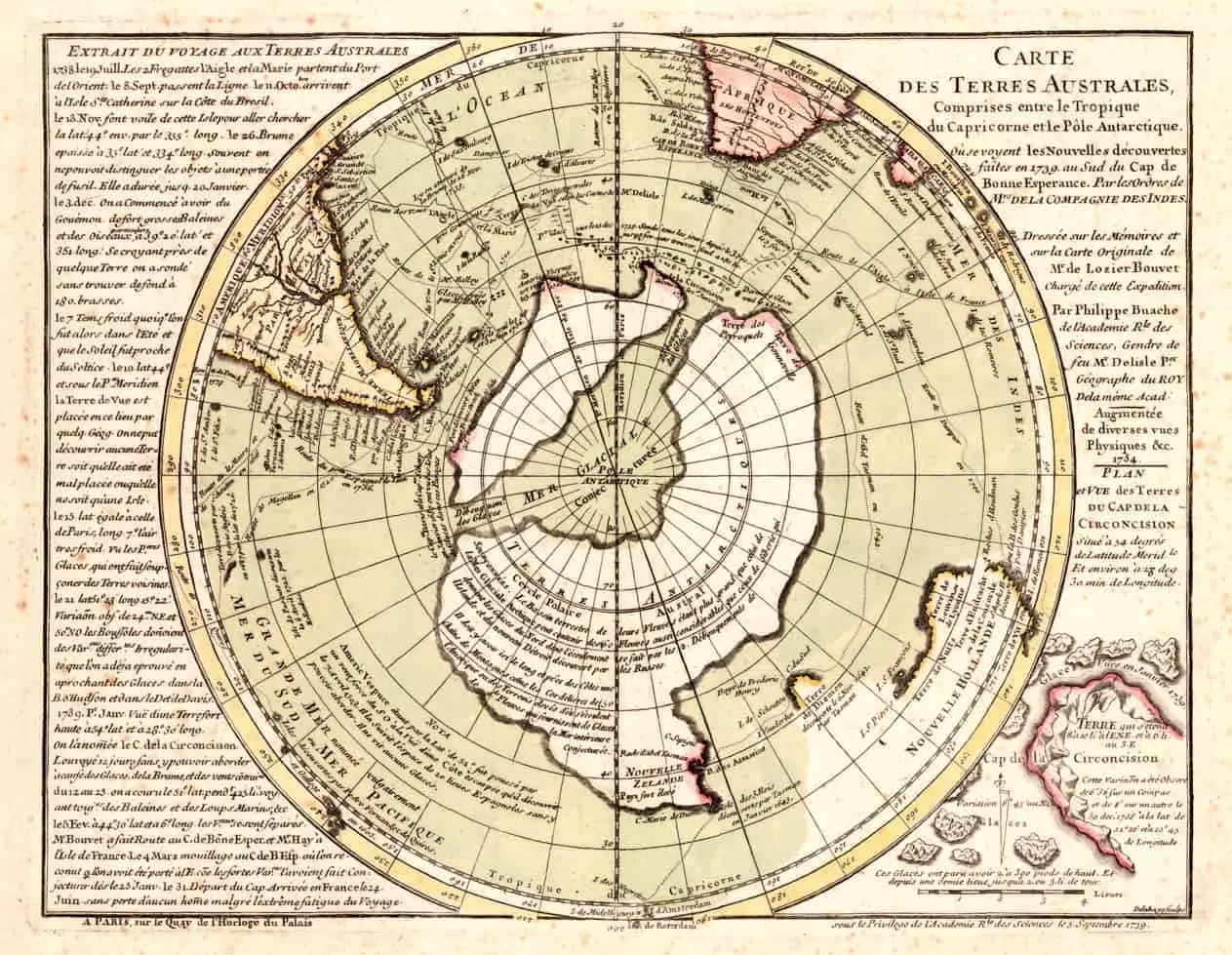
One of those maps is the controversial cartographic chart created by a French geographer by the name of Philippe Buache de la Neuville. The Buache map has two versions. One of the charts is believed to accurately depict the ice-free coastline of Antarctica while the other chart makes no mention of the continent whatsoever. Many indicate that Buache was unaware of the existence of the Icy Continent and that his depictions were nothing more than a hypothesis.
The 18th-century map is claimed to accurately depict the continent of Antarctica before it was buried by thick layers of Ice. The only way for the map to correctly portray this is if someone mapped the Antarctic continent when it was free from ice. However, not many agree with these claims suggesting it was misinterpreted.
The correct name of the map is “Carte des Terres Australes comprises entre le Tropique du Capricorne et le Pôle Antarctique où se voyent les nouvelles découvertes faites en 1739 au Sud du Cap de Bonne Esperance" which translated to English reads: "Map of the Southern Lands contained between the Tropic of Capricorn and the Antarctic Pole, where the new discoveries made in 1739 to the south of the Cape of Good Hope may be seen".
Many people claim that the Bouche Map also accurately positioned the Canary Island. The map issued in 1737 also displays the correct outline of the underwater plateau on which the islands are located. This means that the source of the map used to create it is based on a survey of the shape before glaciers melted and ocean levels rose. Even more interesting is the fact that the Buache Map depicts the waterway which divides the continent of Antarctica into two landmasses.
Claims about the Buache Map and that it depicts the continent of Antarctica Ice-Free are said to have its origins Charles Hapgood’s 1966 book, Maps of the Ancient Sea Kings. Since then, many have claimed that together with other ancient maps, the Buache map was created based on far older maps which are said to have been created by a highly developed ancient civilization. However, many argue that this is incorrect. Today, its difficult to imagine if or not, the Buache map accurately represents the subglacial coastline of Antarctica. Furthermore, many argue that the map itself indicate as to how it was created, making no reference to far older maps.
If we observe the map carefully, we will find that two important words are written on the map: conjecturée (conjectured) and soupçonnée (suspected) are located in the regions depicting the southern continent. (The exact text, written on the map can be found here, translated from French).
 The other map which does not display Antarctica
This indicates, according to some, that the landmass was not seen on older maps, but that the continent was hypothesized by Buache himself.
The truth is that the Buache Map is not the only one of its kind. Today, numerous other ancient maps apparently depict geographical features on our planet that would have been tough for ancient explorers to chart. Whether or not some of these maps were created with the help of far older maps is a mystery. However, it is fascinating to read about them since they offer complete details about ancient maps created in the distant past.
Many people firmly believe that the existence of the Buache Map, the Piri Ries map, and other ancient maps prove that in the distant past, ancient explorers had an extremely well-developed cartography system comparable in precision to the one we have today.
The maps can be interpreted as evidence that ancient mankind knew the exact shape and size of the Earth, contrary to popular beliefs, and used spherical trigonometry, and precise and elaborate mathematical calculations, as if thousands of years ago, an unknown civilization undertook a global-scale project of mapping the entire planet like no one has ever done before.
What do you think?
Reference:
http://www.geographicus.com/P/AntiqueMap/Antarctica-gentlemansmagazine-1763
http://www.ancient-origins.net/artifacts-other-artifacts/buache-map-controversial-map-shows-antarctica-without-ice-005647
https://www.forbiddenhistory.info/?q=node/69
 Lost Civilizations
Rare, ancient maps show how thousands of years ago, an advanced civilization mapped the Earth
YouTube Video Here: https://www.youtube.com/embed/Qt2GYyGTXTs?feature=oembed&enablejsapi=1 Countless maps suggest that before written history, ancient explorers had an extremely well-developed car
 Lost Civilizations
Six Ancient Maps that should not exist according to mainstream Scholars
Numerous maps have been discovered throughout history that even today remain as an enigma to scholars and skeptics. While most of us are familiar with the work of Piri Reis and his maps, he isn’t the
 Lost Civilizations
Atlantis; The Lost Continent
Atlantis; the mythical land of a highly advanced and powerful civilization, but what do we know about them? Atlantis was mentioned in Plato’s dialogues “Timaeus” and “Critias” even though mainstream a