The Nebra sky disk, first thought to be a forgery, is now considered as one of the most important archaeological findings in the 20th century. This object is a bronze disk of around 30 cm diameter and
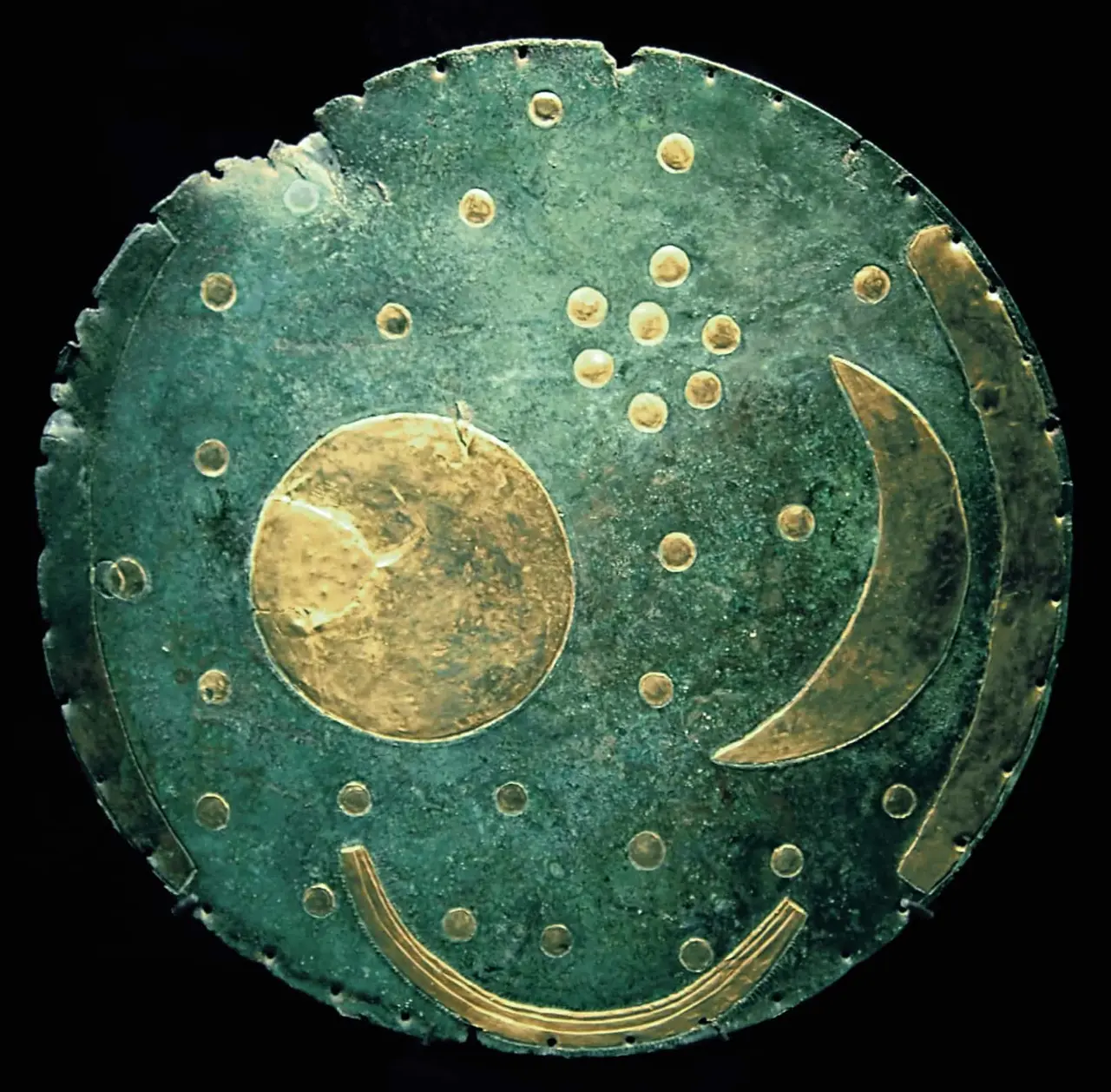
The Nebra sky disk, first thought to be a forgery, is now considered as one of the most important archaeological findings in the 20th century. This object is a bronze disk of around 30 cm diameter and a weight of 2.2 kg, with a blue-green patina and inlaid with gold symbols. The images on the disc are interpreted generally as a sun or full moon, a lunar crescent, and stars, specifically the Pleiades.
But what makes this disk very unique is the fact that this disk is unlike any known artistic style from the period. The Nebra Sky Disc features the oldest concrete depiction of the cosmos worldwide. in June 2013 the Nebra sky disk was included in the UNESCO's Memory of the World Register.
[caption id="attachment_44860" align="alignnone" width="1024"] The Nebra sky disk by Dbachmann via Wikimedia Commons (CC BY-SA 3.0)[/caption]
The disk is attributed to a site near Nebra, Saxony-Anhalt in Germany, and associatively dated to c. 1600 BC. According to researchers, it is at least two hundred years older than the oldest images found in Egypt. The Nebra sky disk was discovered by two "convicted" treasure hunters using a metal detector at a prehistoric enclosure encircling the Mittelberg hill, near the town of Nebra The disk was recovered shortly after by police authorities.
It was a group of German researchers that uncovered evidence that this disk was a complex astronomical clock for the harmonization of solar and lunar calendars, it is considered as the first ever portable navigating system.
But that does not answer any questions regarding the disk that have surfaced since its discovery in 1999. One of the most important markings found on the disk is the representation of the Pleiades; an open star cluster containing middle-aged hot B-type stars located in the constellation of Taurus.
It is among the nearest star clusters to Earth and is the cluster most obvious to the naked eye in the night sky. The celestial entity has several meanings in different cultures and traditions and it is one of the most famous celestial objects (together with the Orion Nebula) in ancient times.
The Bronze Age astronomers would hold the Nebra clock against the sky and observe the position of the celestial objects.
The intercalary month was inserted when what they saw in the sky corresponded to the map on the disc they were holding in their hands. This happened every two to three years. "This is a clear expansion of what we knew about the meaning and function of the sky disc," said archaeologist Harald Meller.
[caption id="attachment_7567" align="aligncenter" width="736"]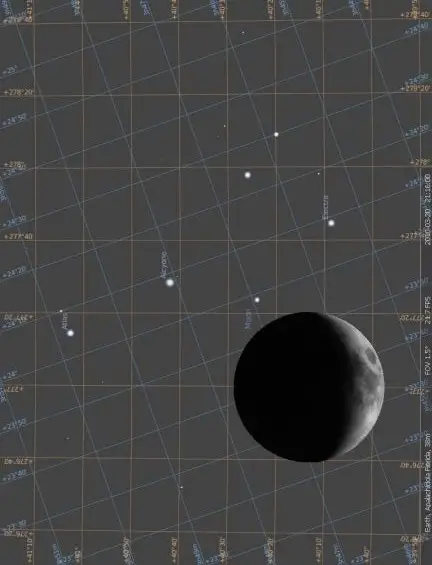 This is an image from the astronomy program Stellarium (free at Sourceforge) on the night of March 20, 2010, when the moon occulted the Pleiades. Notice that it strongly resembles the little dipper. This image is as you would see from earth. We have rotated the image 90 degrees left, and if you compare it to the Sky Disk you will notice that it is the same representation as seen on the Nebra Sky Disk (upper left).[/caption]
"The sensation lies in the fact that the Bronze Age people managed to harmonize the solar and lunar years. We never thought they would have managed that,...The functioning of this clock was probably known to a very small group of people,"The Bronze Age astronomers would hold the Nebra clock against the sky and observe the position of the celestial objects. The intercalary month was inserted when what they saw in the sky corresponded to the map on the disc they were holding in their hands. This happened every two to three years.
According to astronomer Wolfhard Schlosser of the Rurh University at Bochum, the Bronze Age sky gazers already knew what the Babylonians would describe only a thousand years later.
"Whether this was a local discovery, or whether the knowledge came from afar, is still not clear," Schlosser said.
Ever since the disc was discovered, archaeologists and astronomers have been puzzled by the shape of the moon as it appears on the disc. According to the ancient Babylonian rule, a thirteenth month should only be added to the lunar calendar only when one sees the constellation of the moon and the Pleiades exactly as they appear on the Nebra sky disc. -- Article: 2002. (www.dw-world.de)
[caption id="attachment_44863" align="aligncenter" width="1024"]
 Another photograph, at the Pergamon Museum by [/caption]
Soruce:
Wikipedia
http://www.ancient.eu/article/235/
http://www.hope-of-israel.org.nz/
http://www.bbc.co.uk/science/horizon/2004/stardisctrans.shtml
 Mythology & Ancient Knowledge
25 Facts about the constellation of Orion
[caption id="attachment_9439" align="aligncenter" width="725"] The constellation of Orion by Scott Rosen Astrophotography. http://www.astronomersdoitinthedark.com/index.php?c=153&p=472[/caption] N
 Mythology & Ancient Knowledge
The mystery of the 6000 year old Inga Stone
YouTube Video Here: https://www.youtube.com/embed/Hd-GlLQQGkA?feature=oembed&enablejsapi=1 Located in the middle of the Inga River, not far away from the Brazilian city of Inga, stands one of the
 Mythology & Ancient Knowledge
Deciphering Sirius and Orion
Sirius and Orion were the most important stars in the sky to many ancient civilizations including the Ancient Egyptians who gave extreme importance to these stars. But not only did the Ancient Egyptia