

YouTube Video Here: https://www.youtube.com/embed/pV_gXGTuWxY?feature=oembed&enablejsapi=1 It has long been one of the greatest mathematical mysteries, but experts believe they have finally discov
YouTube Video Here: https://www.youtube.com/embed/pV_gXGTuWxY?feature=oembed&enablejsapi=1
It has long been one of the greatest mathematical mysteries, but experts believe they have finally discovered the origin of the symbol currently used to designate the number zero.
Reference to the number zero was found in the Bakhshali, an ancient Indian mathematical text discovered in 1881 whose recent carbon dating 14, carried out by Oxford University experts has traced it back to the third century, meaning its five centuries older than previously believed.
 The numerals used in the Bakhshali manuscript. Image Credit

"Today we assume that the concept of zero is used everywhere and is fundamental to the digital world," said Professor Marcus du Sautoy, lead author of the study.
"But the creation of zero as a number, which evolved from the point found in the Bakhshali manuscript, was one of the greatest advances in the history of mathematics."
"We now know that it was as early as the 3rd century that mathematicians in India planted the seed of the idea that would later become so fundamental to the modern world. The findings show how vibrant mathematics have been in the Indian sub-continent for centuries."
Professor du Sautoy explained how the dot symbol was used as a "marker" to indicate orders of magnitude in a number system—for example, zero denoting the lack of tens in 101.
And while zero as a marker is known in older cultures, such as the Babylonian or that of the ancient Maya, the symbol in the Indian manuscript is significant for two main reasons.
The first is that this dot evolved to have a hollow center that we see in the zero symbol today.
And the second is that it was only in India that zero evolved into what it is today, when Brahmagupta, an Indian astronomer, wrote the Brahmasphutasiddhanta text in the sixth century, the first document to mention zero as a number.
 Image Credit: University of Oxford
Previous research placed the Bakhshali manuscript between the 8th and 12th centuries, mostly based on the writing style.
However, new studies reveal that the ancient manuscript—consisting of 70 extremely fragile leaves of birch bark—is in fact made out of material that is traced back to at least three different periods.
Richard Ovenden, a librarian at the Bodley Library, which is home to the manuscript said how “Determining the date of the Bakhshali manuscript is of vital importance to the history of mathematics and the study of early South Asian culture and these surprising research results testify to the subcontinent's rich and longstanding scientific tradition.”
The ancient manuscript will soon go on public display at the Science Museum in London as part of an exhibition Illuminating ancient India: 5000 Years of Science and Innovation, opening on the 4th of October, 2017.
 Mythology & Ancient Knowledge
The Origin Of The Number Zero
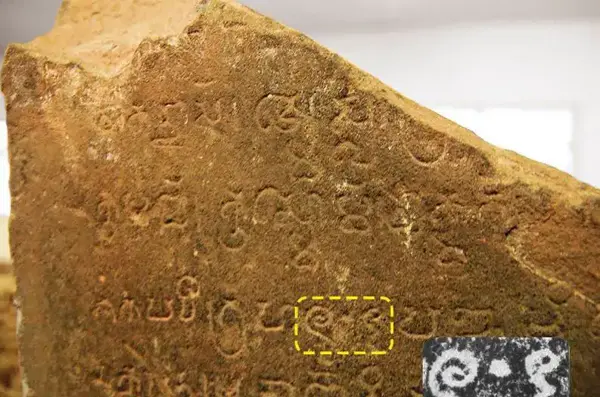
[caption id="attachment_8489" align="aligncenter" width="800"] This inscription, written in Old Khmer, reads “The Caka era reached year 605 on the fifth day of the waning moon.” The dot (at right) is
 Mythology & Ancient Knowledge
Sacred Geometry And The Flower Of Life
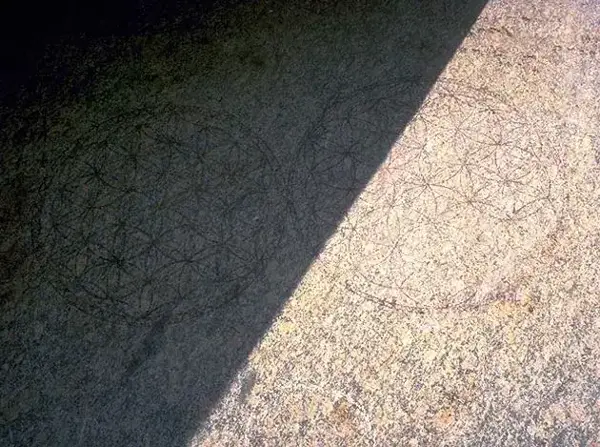
[caption id="attachment_8221" align="aligncenter" width="640"] The Flower of Life symbol drawn in red ochre Temple of Osiris at Abydos, Egypt. Photograph taken by Ray Flowers[/caption] The Flower of l
 Mythology & Ancient Knowledge
Ancient Knowledge? The Secret Importance Behind The Number 3
Throughout human history, the number three has always had a unique significance, but why? If we look back in history at ancient mankind, no matter which culture we observe the number three has always