

If the largest concentration of dolmens on the planet is found on the Korean peninsula, the largest group of megalithic complexes corresponds to the central area of Senegal bordering the north of Gamb
If the largest concentration of dolmens on the planet is found on the Korean peninsula, the largest group of megalithic complexes corresponds to the central area of Senegal bordering the north of Gambia.
Surprised?
So was I!
But this just shows off the huge number of ancient sites that exist on Earth, which most people have no idea of.
In an area of 30,000 square kilometers between the two countries north of Janjanbureh (former Georgetown) we find the megalithic structures of a lost civilization.
These massive monuments are sometimes divided into the Wassu (Gambian) and Sine-Saloum (Senegalese) circles, but this is purely a national division from modern times.
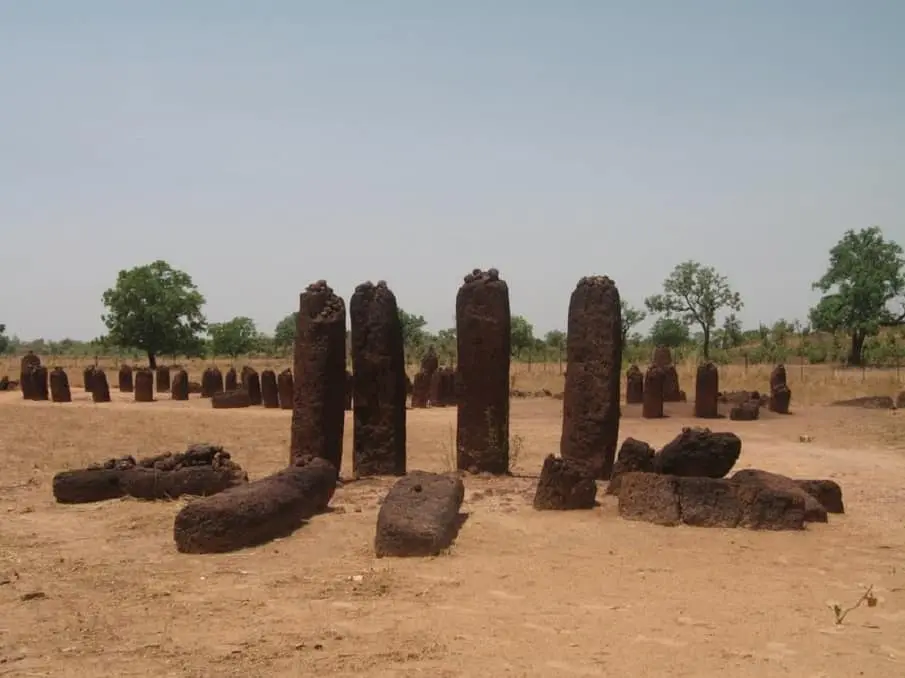
 Wassu Stone Circles. Image Credit: CC BY-SA 2.0 Wikimedia Commons.

The megalithic structures found in Senegal and Gambia are usually divided into four large sites: Sine Ngayene and Wanar in Senegal, and Wassu and Kerbatch in the Central River Region in Gambia.
The monuments itself are a mystery.
So far, experts have not been able to date them, but it is mostly accepted that the megalithic structures were erected between the third century B.C. and the sixteenth century AD.
The megalithic stone circles of Senegambia are home to around 29,000 stones, 17,000 monuments, and 2,000 individual sites.
Archaeologists Todd and Ozanne first studied the monuments in 1903.
 Wassu stone circles. Image Credit: CC BY-SA 2.0 Wikimedia Commons.

The structures were declared a World Heritage Site by UNESCO in 2006.
Todd, together with Wolbach, carried out excavations on the monuments in 1911 and determined that their construction could not be attributed to the cultures that occupied the territories at that time.
Experts note that the construction of the Senegambian stone monuments is evidence of a prosperous and well-organized culture.
This conclusion was reached after experts calculated the amount of labor which was required to build such structures.
 Wassu Stone Circles. Image Credit: CC BY-SA 4.0 Wikimedia Commons.

The stones are believed to have been extracted from laterite quarries with the help of iron tools, although archaeologists have identified few of the quarries which are directly linked to particular sites.
How the ancient builders transported the massive blocks of stones from their quarry to their construction site remains an enigma.
Who these ancient people were is also a mystery.
Some archaeologists believe that the Serer people are the builders of the massive structures.
This theory comes from the fact that the Serer still use funerary houses like those found at Wanar.
 Stone Circles of Senegambia. Image Credit: CC BY 2.0 Wikimedia Commons.
.jpg)
The Serer people are the third largest ethnic group in Senegal making up 15% of the Senegalese population.
Burial mounds with human remains, ceramics, and other objects have been found around the monuments, although the relationship of these tombs with the stone circles is not very clear.
Some theories suggest that the builders of the structures were farmers, since most the circles are located close to rivers, but experts have discovered spears in some of the tombs, which seems to indicate that they were also hunters.
Most experts seem to agree that it is not known exactly if the tombs are prior to the circles, whether they are contemporary to the structures or if they were built later.
According to local legends, the circles would have been built around the tombs of the kings of the ancient empire of Ghana.
 Circles of stone Wassu Gambia. Image Credit: CC BY-SA 3.0 Wikimedia Commons.

The largest monolith is located in Wassu, Gambia, and it has a height of 2.59 meters and is part of a circle that includes another 10 stones.
However, the area that hosts the largest number of circles is Sine Ngayene, in Senegal, with 52 circles, one of them featuring double stone circles, and has a total of1102 stones.
Archaeological excavations carried out in 2002 concluded that some tombs clearly predate the megaliths.
So, in all the mystery that engulfs these megalithic structures, we do know one thing: the area hosts the largest group of megalithic complexes in the world, as we haven’t found so many megaliths in any other part of the world.
Featured image credit: Wikimedia Commons.
 Megalithic Sites
Researchers find a rock with a carving of a Mastodon at the underwater Stonehenge of Lake Michigan
Another incredible discovery has been made as researchers have found a rock carving of a Mastodon at the underwater Stonehenge of Lake Michigan. In 2007, at a depth of twelve meters, researchers found
 Megalithic Sites
7,000-year-old monument three times bigger than Stonehenge discovered in Poland
A huge Stone Age monument has been discovered in Poland, and researchers report the site is 360 feet in diameter, making it three times larger than Stonehenge. It is believed the site was used by Neol
 Megalithic Sites
Stone circle dating to the Bronze Age found hidden in British forest
A British archaeologist recently made an incredible discovery in a forest: A 4.000-year-old stone circle, the first of its kind found in Gloucestershire, the Daily Mail reports : "A 'very significant'