

YouTube Video Here: https://www.youtube.com/embed/n_Zv2Z8Tha0?feature=oembed&enablejsapi=1 The game of chess has been around for a very long time, both fascinating and frustrating players of every
YouTube Video Here: https://www.youtube.com/embed/n_Zv2Z8Tha0?feature=oembed&enablejsapi=1
The game of chess has been around for a very long time, both fascinating and frustrating players of every age for 1,500 years. Now, one of the oldest chess pieces in history may have been found by archaeologists in the Middle East.
Chess can trace its origins to India in the 6th century around 500 AD when it was commonly known as chaturaṅga during the Gupta Empire, considered by historians to have been the Golden Age of India.
From there, the game was taken westward by traders along the Silk Road, reaching the Middle East and then Europe where the rules would evolve over time and the name would change until the word "chess" was derived from the Persian word "shah" or king.
Up until now, the oldest chess pieces in the world were ivory pieces that had been excavated in Uzbekistan dating back to around 760 AD.
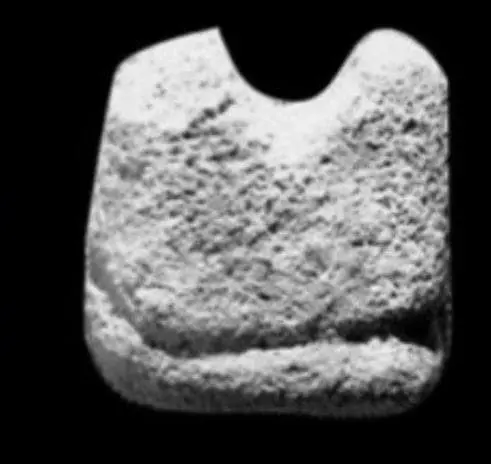
But University of Victoria-British Columbia archaeologist John Oleson believes a find made in 1991 at a site in Jordan should have the title of the oldest chess piece in the world.
The single sandstone piece looks exactly like an ancient rook in the same style in which they would have been carved based on rooks dating back to later centuries.
"A small sandstone object found in an Early Islamic context at Humayma (southern Jordan) in 1991 appears to be the earliest known archaeologically documented chess piece," Oleson wrote in an abstract presentation of the piece to the American Schools of Oriental Research. "Although the shape, rectangular in section with splayed, horn-like projections at the top, resembles a Nabataean altar or betyl, parallels with Early Islamic chess pieces are far more convincing."
 The rook piece found in 1991 at Humayma in Jordan, which dates back to the 7th century and could be the world's oldest chess piece. Image via YouTube.
Indeed, surviving Early Islamic chess pieces share the same two horns at the top and served as rooks, which is also derived from a Persian word. Early Rooks represented chariots instead of castles like they do today, which makes a little more sense if you think of a chessboard as a battlefield.
"The object appears to be a “rook” (or “castle”) and has the typical abstract form for this playing piece favored in the Islamic world," Oleson continued. "There are references to chess-playing in Islamic texts as early as A.H. 23/A.D. 643, and the game was popular throughout the Islamic world by the end of the Umayyad caliphate."
 12th-century chess set from the Middle East featuring horned rooks. Image via the Met Museum.
One of the largest empires in history, the Umayyad caliphate was the second of four caliphates established after the death of Muhammad, the founder of Islam. Based in Damascus, Syria, the caliphate would usher in the Golden Age of Islam and became a center of science and philosophy, making it obvious as to why chess could so easily flourish in the region at the time.
Humayma is the modern name of the ancient trading post known as Hawara that had been founded in the 1st century by the Nabataean king Aretas III. A popular and strategic trading post, the city boasts Nabataean, Roman, Byzantine and Islamic influences that can still be seen today, including Roman baths, several Byzantine churches and an Islamic palace from the Umayyad period.
We know that chess was widely played by those of different cultural, religious and economic statuses. And in a trading post like Humayma, that means Christians and Muslims likely played chess together, as did the rich and poor and people who came from different regions. It's like how sports bring people together today despite our differences.
 The ruins of the ancient trading post of Humayma in Jordan, where the chess piece was found in 1991. Image via Wikimedia.
"Several later abstract “rooks” from Jordan and elsewhere in the Near East, carved in stone, wood, or ivory, are nearly identical to the Humayma object in design and scale," Oleson wrote. "Since the Humayma object was found in a seventh-century context, if the identification as a chess piece is correct, it would be the earliest known physical example for the simplified, abstract design, and possibly the earliest known example of a chess piece altogether."
A 12th-century chess set from the Middle East, for example, include rooks carved in the same shape. While rooks of that time represented chariots, there was also a king represented by a throne, a vizier in the queen position represented by a smaller throne, a bishop represented by an elephant, a knight represented by a horse and pawns represented by multi-faceted hemispheres with knobs. Of course, the makeup of chess sets varied, so pieces came in many shapes, sizes, and representations.
For instance, a 12th-century Norwegian chess set featured several intricately detailed pieces known as the Lewis Chessman, a complete medieval chess set carved out of walrus ivory and found in Scotland in 1831.
 Lewis Chessman dating back to the 12th century displayed at the British Museum. Image via Wikimedia.
Queen's Chess
By the 10th century, the queen would replace the vizier piece and would become the most powerful piece on the board by the 15th century, giving rise to the term "Queen's Chess" to describe the game.
Oleson speculates that chess had made its way to the trading post by way of merchants and diplomats.
"Since the game probably was carried westward from India by the movement of merchants and diplomats, it is no surprise that early evidence for it should be found at a site on the busy Via Nova Traiana," he noted. "While resident at Humayma, the Abbasid family had kept itself abreast of events in Syria and Iraq along this same route."
The Via Nova Traiana was an ancient road built by the Romans, starting during the reign of Emperor Trajan and being completed under Emperor Hadrian, who also commissioned the building of Hadrian's Wall in the United Kingdom.
 The Via Maris (purple), King's Highway (red), and other ancient Levantine trade routes, c. 1300 BCE. by Briangotts via Wikimedia Commons (CC BY-SA 3.0)
The Abbasid family Oleson speaks of is the Abbasid Caliphate, the third of the Islamic caliphates that ruled the region after overthrowing the Umayyad caliphate. They would rule the empire politically until around the mid-1200s and would be able to claim religious authority until the Ottomans conquered Egypt in 1517.
By then, chess was well established.
If further analysis proves that this piece is a rook dating back to the 7th century, it would be the oldest chess piece in the world. And seeing as how Oleson currently stores the piece in his basement, he should strongly consider moving it to a more secure place because a Lewis Chessmen piece recently sold for over $700,000. An older piece could draw a similar amount or higher. Nevertheless, this is an extraordinary piece that helps tell the story of chess and, frankly, it belongs in a museum where all chess enthusiasts can enjoy it.
See more from Lazy News
Featured Image: Lewis chessmen by Nachosan via Wikimedia Commons (CC BY-SA 3.0)
 Archaeology & History
German Cave Reveals Clues About the First Domesticated Wolves
YouTube Video Here: https://www.youtube.com/embed/16SySpAWDpQ?start=4&feature=oembed Scientists have found new important clues about the first domesticated wolves and dogs. A small cave in Germany
 Archaeology & History
Is There a Connection Between Petroglyphs in Georgia and Bronze Age Europe?
Petroglyphs found in Georgia show a possible connection between some of the earliest archaeological sites in the United States and Bronze Age Europe. Symbols found etched into stone are remarkably sim
 Archaeology & History
Infants found buried in Ecuador were wearing 'helmets' made from other children's skulls
YouTube Video Here: https://www.youtube.com/embed/maaX8VvOOtQ?feature=oembed&enablejsapi=1 Salango is located on the coast of central Ecuador, and archaeologists recently made an astonishing find