

Researchers have discovered an ancient tomb that has remained untouched for more than 3,500 years in Crete, uncovering the grave of a Minoan man who died around 1,400 BC, when the Island was ruled by
Researchers have discovered an ancient tomb that has remained untouched for more than 3,500 years in Crete, uncovering the grave of a Minoan man who died around 1,400 BC, when the Island was ruled by a civilization featured in the Minotaur.
In Brief: Archaeologists and archaeology students were called to the scene, where they unearthed an intact, vaulted tomb measuring about 13 feet long, complete with carvings, two skeletons, and about two dozen vases.
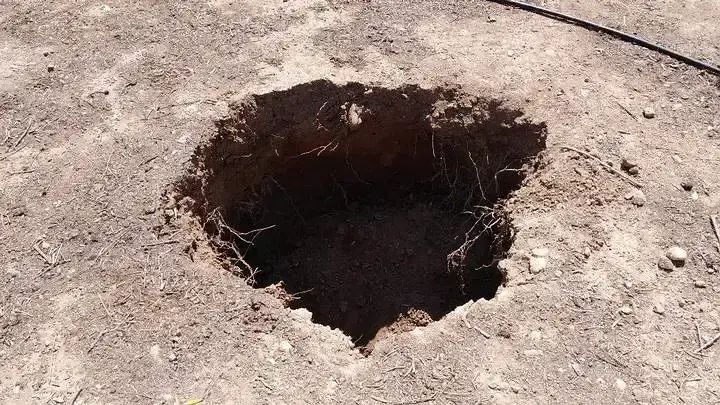
The grave was inadvertently discovered by a local resident after he stumbled across an underground cavern sealed in ancient times using clay.
 The entrance to the underground tomb.
The tomb and the artifacts are believed to date back to the Bronze age, sometime between 1,200 and 2,400 BCE.
The burial was discovered in an olive grove near the town of Ierapetra, around two and a half meters below the surface and contained a number of funerary possessions such as a cup, a wine-mixing vessel and around fifteen amphorae containers.
According to the Greek Ministry of Culture, the tomb, which was discovered via a vertical channel, was divided into three different chambers.
 The interior of the Minoan Tomb.
At the southern end, there was an intact sarcophagus with the lid in place and, inside, the well-preserved skeleton of an adult person "in a very contracted posture," according to the statement.
 The skeletal remains discovered inside the tomb.
In the northernmost end, there was a sarcophagus without a lid and inside it a very deteriorated adult skeleton, in addition to other ceramic vessels.
The Myth
The Minoan civilization arose on the Mediterranean island of Crete sometimes around 2600BCE and flourished for around 12 centuries until around 1400BC.
Evidence of the civilization's existence was uncovered in 1900 when British archaeologist Sir Arthur Evans unearthed Knossos, the capital of the Minoan Civilization.
The ancient city of Knossos is thought to have been the legendary home of King Minos, who commissioned the 'labyrinth' in order to contain the Minotaur, a strange, terrifying creature with the head and tail of a bull and the body of a man.
The Minotaur dwelt at the center of the Labyrinth, which was an elaborate maze-like construction designed by the architect Daedalus and his son Icarus, on the command of King Minos of Crete. The Minotaur was eventually killed by the Athenian hero Theseus.
 Archaeology & History
German Cave Reveals Clues About the First Domesticated Wolves
YouTube Video Here: https://www.youtube.com/embed/16SySpAWDpQ?start=4&feature=oembed Scientists have found new important clues about the first domesticated wolves and dogs. A small cave in Germany
 Archaeology & History
Is There a Connection Between Petroglyphs in Georgia and Bronze Age Europe?
Petroglyphs found in Georgia show a possible connection between some of the earliest archaeological sites in the United States and Bronze Age Europe. Symbols found etched into stone are remarkably sim
 Archaeology & History
World's oldest chess piece could be a rook dating back to the 7th century
YouTube Video Here: https://www.youtube.com/embed/n_Zv2Z8Tha0?feature=oembed&enablejsapi=1 The game of chess has been around for a very long time, both fascinating and frustrating players of every