

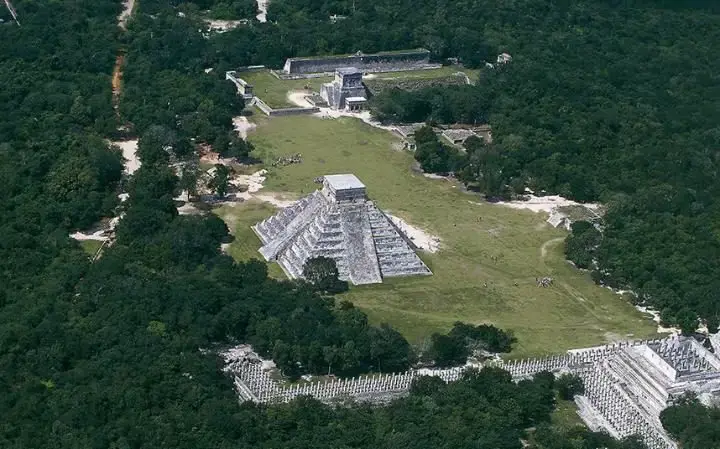
New analysis of the Pyramid of Kukulkan has allowed experts to make a fascinating discovery: There is another Pyramid located withing the Pyramid of Kukulakn at Chichen Itza. Experts say that the stru
New analysis of the Pyramid of Kukulkan has allowed experts to make a fascinating discovery: There is another Pyramid located withing the Pyramid of Kukulakn at Chichen Itza. Experts say that the structure appeared to have a staircase and perhaps an altar at the top.
Mexican Archaeologists have discovered a second mysterious sub-structure (Mini Pyramid) located within the Mayan pyramid of Kukulcan, in Chichen Itza which dates back between 550 and 800 AD, reports indicate it measures 13 meters in height and 18 meters in width.
Interestingly in 1930, excavations revealed another 'structure' located within the pyramid which contained a red Jaguar throne.
During a press conference, experts from the National Autonomous University of Mexico and the National Institute of Anthropology and History (INAH), commented that the geophysical tests applied to the so-called 'El Castillo Pyramid' - also called Kukulcan - revalidate the presence of an ancient cenote under the pyramid, whose discovery was announced in August 2015.
"The structure that we have found, the new structure, is not completely in the center of the Kukulkan pyramid. It is in the direction where the cenote is," said Rene Chavez Segura, a scientist at the National Autonomous University of Mexico, or UNAM.
"This could either confirm or hypothesize that the Mayans when they built this structure that they knew of the existence of this cenote."
Researchers used a world-class innovative technology developed by themselves –tri-dimensional electric resistivity tomography.
Using commercial and non-invasive geophysical exploration tools, experts placed electrical detectors around the pyramid and transmitted current to "illuminate" the interior of the pyramid and obtain data through analyzing the difference and the resistivity of the subsoil.
According to experts from UNAM and the INAH, the structure discovered by experts in 1930 belonged to the transitional pyramid of the ancient Maya while the newly found pyramid inside the pyramid is from the pure Mayan style.
"If this could be investigated in the future, this structure would be significant because it would speak to the first few periods of habitation of the site and would provide information about how the settlement developed," said Denisse Argote from the National Institute of Anthropology and History.
"With the discovery of this structure, we're talking about something from the pure Mayans. A lot has been excavated, and there is a lot of information on the transitional periods (of the Mayas) and there is a Mexican style at the site, but there is little information on the original site," she added.
 Mesoamerica & the Andes
The Mystery Of King Pakal: Did he lift off to the stars?
We've all heard about the ancient alien theory, some of us enjoyed the famous series on TV while others tried constantly to debunk every single point of it. Like everything in life, there are cons and
 Mesoamerica & the Andes
3 Reasons why the Ancient Maya Collapsed
The ancient Maya were a Mesoamerican civilization that flourished in the jungles of present-day Mexico(south), Guatemala and Belize. This mysterious ancient civilization was one of the most important
 Mesoamerica & the Andes
Why Do Ancient Maya Temples Resemble In Great Detail Ancient Indonesian Temples?
Located on the western slope of Mount Lawu we can find the Javanese-Hindu temple of Sukuh believed to date back to the 15th century and a fifth-century Javanese-Hindu temple called the Cetho temple. T